HANKUKIN Now
Seeing a Doctor in Korea: Walk In, No Appointment Needed
If you get ill in Korea, you do not book anything. You walk into a neighbourhood clinic, wait twenty minutes, and collect your medicine from the pharmacy in the same building. Without Korean insurance a cold visit runs roughly ₩50,000–80,000 — more than a resident pays, still far less than the American equivalent, and available today rather than in three weeks.
The single most useful thing to know about Korean healthcare as a visitor is not the price. It is this:
There is nothing to book.
You walk into a neighbourhood clinic, give your name at the desk, sit down, and see a doctor — usually within half an hour, on the same day, without having spoken to anyone in advance. That is the ordinary way it works for everyone here, and it is why Koreans go to the doctor for things that people elsewhere would sleep off.
If you feel a cold coming on in a Korean winter, you do not have to decide whether it is worth the trouble. There is barely any trouble.
What it costs without Korean insurance
Let us be precise about this, because the number you will see quoted around the internet is usually the resident number and you are not a resident.
Korea’s national health insurance (국민건강보험) covers residents, including foreigners on long stays who are enrolled. A short-term visitor is not enrolled and pays the full amount rather than a co-payment.
| Typical cost of a cold / clinic visit | |
|---|---|
| Korean resident with national insurance | ₩10,000 – 20,000 |
| You, as a visitor without it | ₩50,000 – 80,000 |
Medicine from the pharmacy is on top, and for a few days of cold medication it is usually modest.
Say the visitor number out loud: roughly ₩50,000–80,000, about US$36–58. That is three to five times what a local pays and it is still, for most visitors, less than a doctor’s appointment at home.
How that compares
Two comparisons, and they are different in character.
On price, the like-for-like comparison is the United States, because there too an uninsured person pays the full amount at the counter.
| Uninsured / non-covered visit | |
|---|---|
| Korea | ₩50,000 – 80,000 (≈ US$36 – 58) |
| United States | US$40 – 300, averaging about $171 |
On access, the comparison is everyone. This is the figure that surprises people more than the money.
| Typical wait for a general practitioner | |
|---|---|
| Korea | None — walk in, same day |
| United States | about 21 days to get an appointment |
| United Kingdom | about 10 days |
| Germany | about 4 days |
| Australia | about 4 days |
That is the real headline. In much of the world, “see a doctor about this cold” means an appointment next week, by which time the cold is over. In Korea it means walking down the street.
Which sign to look for
Korean clinics are named by specialty, and the signs are almost never in English. These are the ones worth recognising.
| Sign | Read it | What it treats |
|---|---|---|
| 내과 | nae-gwa | Internal medicine — colds, flu, stomach, fever. This is the one. |
| 이비인후과 | i-bi-in-hu-gwa | Ear, nose and throat — sore throat, sinuses, blocked ears |
| 정형외과 | jeong-hyeong-oe-gwa | Orthopaedics — bones, joints, sprains, back |
| 피부과 | pi-bu-gwa | Dermatology — skin, rashes |
| 안과 | an-gwa | Eyes (for glasses you want an optician, not this) |
| 치과 | chi-gwa | Dentistry |
| 소아청소년과 | so-a-cheong-so-nyeon-gwa | Children |
| 한의원 | han-ui-won | Korean medicine — acupuncture, herbal |
And three words that tell you what kind of place you are looking at:
| Sign | Read it | What it is |
|---|---|---|
| 의원 | ui-won | A local clinic. One or two doctors. This is where you go. |
| 병원 / 종합병원 | byeong-won | A hospital. Bigger, slower, more expensive. Not for a cold |
| 응급실 | eung-geup-sil | Emergency room. Expensive and slow for anything minor |
The practical rule: look for 의원, and for a cold look for 내과.
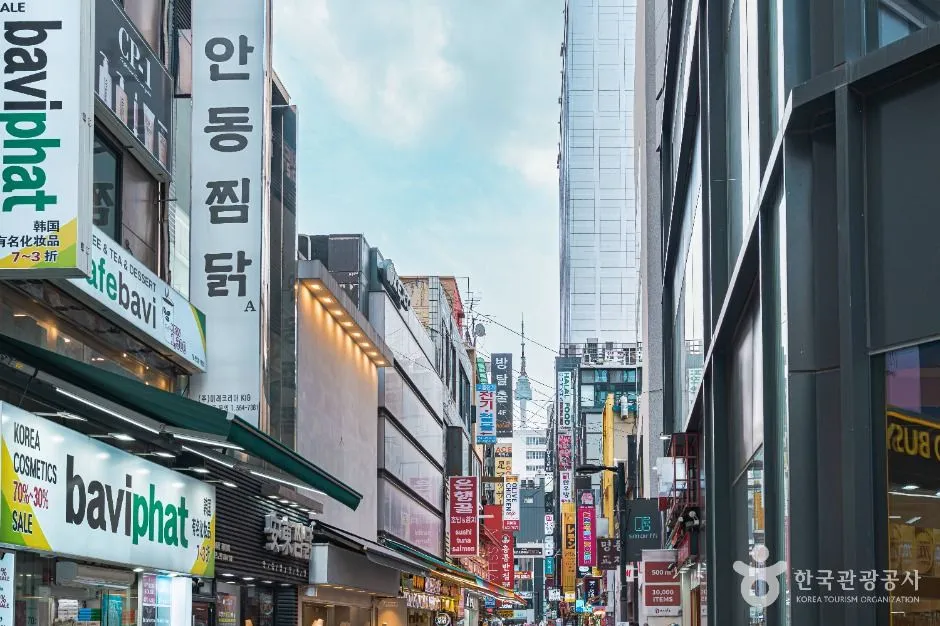
And look up. Clinic names are stacked vertically down the outside wall, because the ground floor goes to shops and the upper floors go to everything else. Almost nothing you need in Korea is at eye height.
The pharmacy is in the same building
This is the second thing nobody tells visitors, and it removes the step people worry about.
Korean doctors do not hand you medicine. They give you a 처방전 (cheo-bang-jeon), a prescription slip, and you take it to a 약국 (yak-guk) — a pharmacy.
The pharmacy is almost always on the ground floor of the same building, or the one next door. This is not luck; pharmacies deliberately sit under clinics. You will often walk out of the lift and see the green 약국 sign through the front door.
Hand over the slip. Pay. Leave. You do not need to say anything else, and the medication comes portioned into small packets marked by dose and time of day.
What to bring and what to expect
Your passport. That is the identification they will ask for.
A translation app. Many clinic staff speak limited English, and this is the one situation where you want to be precise. Korea also runs the 1330 tourist helpline, which offers interpretation.
Payment by card. Universal.
Travel insurance receipts. Ask for a 진료비 영수증 (jin-ryo-bi yeong-su-jeung), an itemised receipt, if you intend to claim.
Expect to be seen quickly and briefly. Korean primary care is fast — consultations are short by British or American standards. This is not dismissiveness; it is the model, and it is part of why access is what it is.
Where the honesty belongs
We are not telling you to see a doctor. We are telling you that if you want to, the barriers most visitors expect — booking, cost, finding the place, filling a prescription — are much lower here than they are in most of the countries our readers come from.
Serious illness or injury is a different article. Everything above is about minor, ordinary complaints at a local clinic. Emergencies, hospital admission and anything requiring imaging or surgery cost dramatically more and are outside what we have researched.
Get travel insurance anyway. A cold is ₩50,000. A fracture, an ambulance or a night in hospital is not, and non-covered foreign patients pay the whole amount.
Related
- Read the signs — the alphabet takes about ninety minutes and makes every sign above legible
- Buying glasses in Korea — same pattern: walk in, ten minutes, no appointment
- Korean phrases for shops
What this article does not claim
We are not doctors and this is not medical advice. Nothing here is a recommendation about whether to seek care or what care to seek. It is a description of how the system is arranged and what it costs.
The Korean visitor figure is the weakest number on this page. ₩50,000–80,000 for a non-insured cold consultation is the range reported in Korean guidance material for foreigners; we have not confirmed it against a primary tariff published by a government body, and clinic fees are not uniform. Treat it as an order of magnitude. The structural fact — that non-enrolled visitors pay the full amount rather than a co-payment — is the part we are confident in, and it follows from the national insurance rules linked in the sources.
The international cost comparison is limited to the United States on purpose. Figures circulate for GP visits in the UK, Germany and Australia, but those are what residents or their systems pay. A visitor without local coverage in those countries pays a private fee, which is much higher, and comparing our full-price figure against their resident figure would make Korea look expensive when it is not. We would rather compare one country honestly than five misleadingly.
Wait-time figures are from a 2024 international comparison survey, are averages across whole countries, and describe getting an appointment rather than time spent in a waiting room. Korean walk-in access is a structural feature rather than a surveyed number.
“The pharmacy is in the same building” is the strong general pattern, not a guarantee. Occasionally you will walk a block.
Costs change, dental and specialist care are not covered here at all, and prices differ between Seoul and elsewhere. Checked 15 August 2026.
Read next
Sources & last checked
- Aggregate data · checked 2026-08-15 외국인 한국 병원비, 보험 없으면 얼마? (비가입자 진료비 사례)
- Public institution · checked 2026-08-15 장기체류 재외국민 및 외국인에 대한 건강보험 적용기준 — 국민건강보험공단
- Media · checked 2026-08-15 How Much Is a Primary Care Visit Without Insurance? — Zocdoc (US uninsured pricing)
- Aggregate data · checked 2026-08-15 Healthcare wait times across the world (2024) — Compare the Market