HANKUKIN Hangul
Read Korean in 90 Minutes: The Alphabet, Starting at ㄱ
Korean writing looks like a wall. It is not — it is 24 letters in an alphabet designed in the 1440s to be learnable in a morning, and the consonants are literally diagrams of your mouth. This is the whole system, in order, with real shop signs to practise on. You will not speak Korean at the end. You will read it.

Korean writing looks, at first, like a wall.
It is not a wall. It is 24 letters in an alphabet that was deliberately designed to be learnable quickly — and unlike almost every other writing system on earth, we know exactly who designed it, when, and why.
You can learn to read Korean aloud in about ninety minutes. Not understand it. Read it. And that alone changes a trip, because the moment you can sound out a sign you can tell a pharmacy from a clinic, a noodle shop from a barbecue place, and your station from the one after it.
This is part one of a series on reading Korea. We start where the alphabet starts: ㄱ.
Why it is this easy
Most writing systems grew. Hangul was invented — promulgated in 1446 under King Sejong, in a document called the Hunminjeongeum, whose stated purpose was that ordinary people who could not learn Chinese characters should be able to write.
That purpose is visible in the shapes. The consonants are diagrams of what your mouth is doing.
- ㄱ — the back of the tongue rising to block the throat. Make a g sound and feel it.
- ㄴ — the tongue tip touching the ridge behind your upper teeth.
- ㅁ — a closed mouth, seen from the front.
- ㅅ — a tooth.
- ㅇ — the throat, open and round.
Everything else is built from those five by adding a stroke. This is the trick that makes the whole set memorable: you are not learning 14 shapes, you are learning 5 shapes and a rule.
The consonants, in order
The order below is the Korean dictionary order — worth knowing, because it is the order of everything from indexes to seat labels.
| Sound | Built from | |
|---|---|---|
| ㄱ | g / k | base shape — tongue and throat |
| ㄴ | n | base shape — tongue and ridge |
| ㄷ | d / t | ㄴ + a lid |
| ㄹ | r / l | a single flap, between English r and l |
| ㅁ | m | base shape — the mouth |
| ㅂ | b / p | ㅁ opened upward |
| ㅅ | s | base shape — a tooth |
| ㅇ | silent / ng | base shape — the throat. See the rule below |
| ㅈ | j | ㅅ + a lid |
| ㅊ | ch | ㅈ + a breath stroke |
| ㅋ | k | ㄱ + a breath stroke |
| ㅌ | t | ㄷ + a breath stroke |
| ㅍ | p | ㅂ + a breath stroke |
| ㅎ | h | the throat with breath |
Notice the pattern in the last five. Adding a stroke adds a puff of air: ㄱ→ㅋ, ㄷ→ㅌ, ㅂ→ㅍ, ㅈ→ㅊ. Hold your hand in front of your mouth and say ga then ka; the extra stroke is the extra breath.
And doubling doubles the tension. ㄲ ㄸ ㅃ ㅆ ㅉ are the same consonants said tighter and harder. You do not need to produce them yet — you need to recognise that ㄲ is ㄱ, twice.
The vowels, from three strokes
The vowels come from three symbols, which the original text describes as heaven, earth and the human being:
| Shape | What it is | What it stands for |
|---|---|---|
| · | A dot | Heaven — now written as a short stroke |
| ㅡ | A flat line | Earth |
| ㅣ | An upright | The human |
Combine them and you get everything:
| Sound | Sound | ||
|---|---|---|---|
| ㅏ | a — father | ㅑ | ya |
| ㅓ | eo — son | ㅕ | yeo |
| ㅗ | o — go | ㅛ | yo |
| ㅜ | u — moon | ㅠ | yu |
| ㅡ | eu — no English equivalent | ㅣ | i — machine |
The rule that saves you memorising ten of them: a second short stroke adds a y. ㅏ→ㅑ, ㅓ→ㅕ, ㅗ→ㅛ, ㅜ→ㅠ. That is the whole of the right-hand column.
ㅡ is the one that has no English partner. It is made with the lips spread flat and the tongue high — closest to the vowel in good, said without rounding your lips. It is everywhere in Korean, so it is worth two minutes.

The one structural idea: letters stack into blocks
This is the part that makes Korean look unlike other alphabets, and it takes two minutes to understand.
Korean letters are not written in a line. They are packed into square syllable blocks.
Each block is one syllable, and you read it left to right, then top to bottom, exactly like a tiny page.
| Letters | Block | Sound | Why it sits there |
|---|---|---|---|
| ㄱ + ㅏ | 가 | ga | Vowel is upright → it goes to the right |
| ㄱ + ㅗ | 고 | go | Vowel is flat → it goes below |
| ㄱ + ㅏ + ㅁ | 감 | gam | A third letter always goes underneath |
The vowel’s own shape tells you where it goes. Upright vowels (ㅏ ㅓ ㅣ ㅑ ㅕ) stand to the right of the consonant. Flat vowels (ㅗ ㅜ ㅡ ㅛ ㅠ) lie underneath it. A final consonant always goes at the bottom.
That is the entire layout system. Once you have it, you are reading.
The ㅇ rule, which trips everyone
ㅇ at the start of a block is silent. It is a placeholder, there because every block must begin with a consonant slot.
ㅇ at the bottom of a block is ng.
| Block | Letters | Sound |
|---|---|---|
| 아 | ㅇ (silent) + ㅏ | a |
| 앙 | ㅇ (silent) + ㅏ + ㅇ | ang |
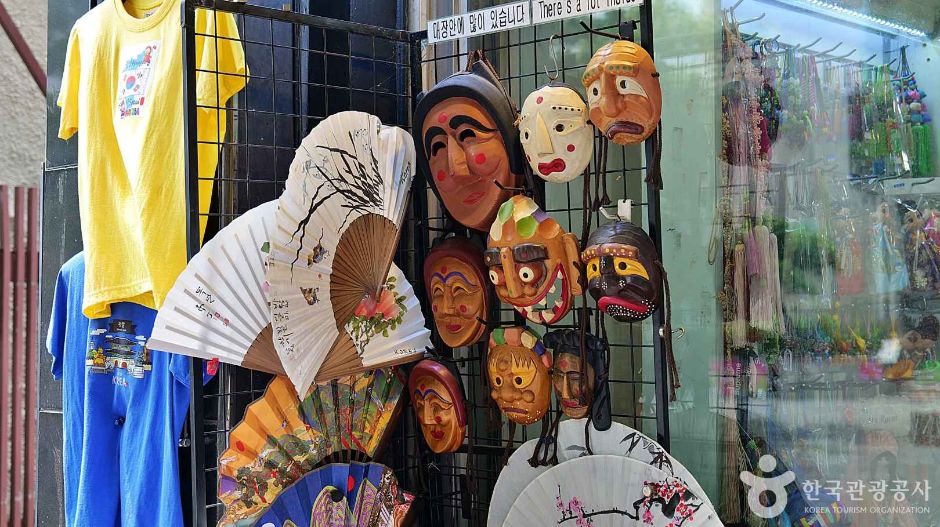
So 인사동 — the name on this page’s photograph — reads:
| Block | Letters | Sound |
|---|---|---|
| 인 | ㅇ (silent) + ㅣ + ㄴ | in |
| 사 | ㅅ + ㅏ | sa |
| 동 | ㄷ + ㅗ + ㅇ (ng) | dong |
In-sa-dong. You just read a Korean sign.

Five signs to practise on
Read these aloud. The point is not to know what they mean yet — it is to prove the system works.
| Sign | Read it | It says |
|---|---|---|
| 약국 | ㅇ-ㅑ-ㄱ / ㄱ-ㅜ-ㄱ | yak-guk — pharmacy |
| 커피 | ㅋ-ㅓ / ㅍ-ㅣ | keo-pi — coffee |
| 김밥 | ㄱ-ㅣ-ㅁ / ㅂ-ㅏ-ㅂ | gim-bap — gimbap |
| 버스 | ㅂ-ㅓ / ㅅ-ㅡ | beo-seu — bus |
| 화장실 | ㅎ-ㅘ / ㅈ-ㅏ-ㅇ / ㅅ-ㅣ-ㄹ | hwa-jang-sil — toilet |
Notice what happened with 커피 and 버스. They are English words written in Korean letters. A surprising share of Korean signage is exactly this — coffee, bus, taxi, cafe, market — which means that the moment you can read Hangul, you can already understand a slice of it without knowing any Korean at all.
That is the single best reason to spend the ninety minutes.
What to do next
Learn the blocks, not the letters. Reading letter by letter is slow and you will give up. Reading syllable blocks as units is fast, and it happens naturally after a few dozen signs.
Practise on things you already know. Subway station names, coffee chains, convenience stores. You know what they say, so you are only checking the sounds.
Do not worry about pronunciation rules yet. Korean changes sounds where blocks meet — 신라 is read Silla, not Sinra. Those rules exist and they are consistent, and they are part five of this series. You do not need them to find a pharmacy.
Coming next in this series
- Part 2 — the signs on a Korean street: what each kind of shop calls itself, so you can tell a barbecue place from a noodle shop from a bar before you walk in.
- Part 3 — medical signs: 내과, 이비인후과, 정형외과, 치과, 안과 — what to look for when you are unwell, and why the pharmacy is almost always in the same building.
- Part 4 — the room words: 노래방, 찜질방, PC방 and the other sign endings that name a business after the room you do the thing in.
- Part 5 — the sound-change rules, for when reading aloud starts to matter — and why the roman line under the Hangul keeps disagreeing with you.
Meanwhile: the phrases people actually say in shops and restaurants.
What this article does not claim
Reading is not understanding. At the end of this page you can pronounce Korean words. You will not know what most of them mean. Those are two different skills and this series does the first one first, deliberately, because it is the one that pays off immediately on a street.
The romanisation here is approximate. We have written sounds as an English speaker would read them rather than in strict Revised Romanisation, because the goal is to be understood out loud. Official romanisation on road signs will sometimes differ from what we have written.
“Ninety minutes” is a widely repeated claim about Hangul, not a measured result. It reflects the fact that the system is small and regular. How long it actually takes you depends on you, and reading fluently — as blocks rather than letters — takes longer than reading at all.
The mouth-shape explanations are the traditional account given in the Hunminjeongeum Haerye, the 1446 commentary that explains the design. Scholars debate details of the derivation; we have given the account the document itself gives.
We have not covered the double consonants (ㄲ ㄸ ㅃ ㅆ ㅉ) or the compound vowels (ㅐ ㅔ ㅘ ㅚ ㅢ and others) properly. They are real, they are common, and they belong in part two. What is here is enough to read most signs; it is not the complete alphabet.
Sound changes between blocks are not covered at all. 신라 → Silla, 국물 → gungmul. If you read strictly letter by letter you will be understood, but you will not sound right. That is part five.
Read next
Sources & last checked
- Public institution · checked 2026-08-15 한글 맞춤법 · 표준어 규정 — 국립국어원
- Public institution · checked 2026-08-15 훈민정음 (해례본) — 국가유산청 국가유산포털
- Public institution · checked 2026-08-15 국립한글박물관