HANKUKIN Now
Is Korean Food Halal or Vegetarian? The Hidden Pork and Fish
A soup called 'potato stew' is built on pork spine. Kimchi is a vegetable dish made with fermented shrimp. Most Korean soup stock is anchovy or beef even when nothing in the bowl looks like either. If you avoid pork, fish or meat, these are the dishes that catch people out — and the exact question to ask.
Most guidance for travellers with dietary restrictions in Korea lists restaurants. This page does something different: it tells you what the dishes themselves are made of, so you can read a menu anywhere.
The problem in Korea is rarely the obvious dish. Nobody is surprised that samgyeopsal is pork. The problem is the bowl of vegetables that was seasoned with fermented fish, and the soup named after a potato.
The one that catches everyone
감자탕 — gamjatang, literally “potato stew.”
It is pork spine. Potatoes are in it, and they are not the point. The name is the single most reliable trap on any Korean menu, and it is on almost every one.
Dishes that are pork by definition
These are not vendor-dependent. This is what the dish is.
| Dish | What it is |
|---|---|
| 순대 sundae | Filling packed into pig intestine. The standard pork version also contains pig’s blood |
| 감자탕 gamjatang | Pork spine |
| 족발 jokbal | Pig’s trotter |
| 보쌈 bossam | Boiled pork belly |
| 삼겹살 / 목살 | Pork belly / pork shoulder |
| 부대찌개 budae jjigae | Built on ham and sausage |
| 돈까스 donkkaseu | Pork cutlet |
On sundae: the Encyclopedia of Korean Culture defines it as filling cooked inside the intestine of pig or cattle, and describes the standard pork preparation as pig intestine filled with pig’s blood and vegetables. Regional versions exist that use fish or squid instead — but if you are handed sundae at a market stall in Seoul, assume pork.
Dishes that look vegetarian and are not
This is the larger category, and the one that causes actual distress.
김치 — kimchi. It is a vegetable dish. It is usually not vegetarian. Most kimchi is made with jeotgal — salted fermented seafood, typically shrimp or anchovy. UNESCO’s own description of kimjang, the communal kimchi-making tradition, lists seafood among the ingredients. Vegan kimchi exists and is sold as such; the default is not it.
나물 — seasoned vegetable side dishes. Frequently dressed with aekjeot, fish sauce. They arrive at your table free, in small dishes, looking entirely plant-based.
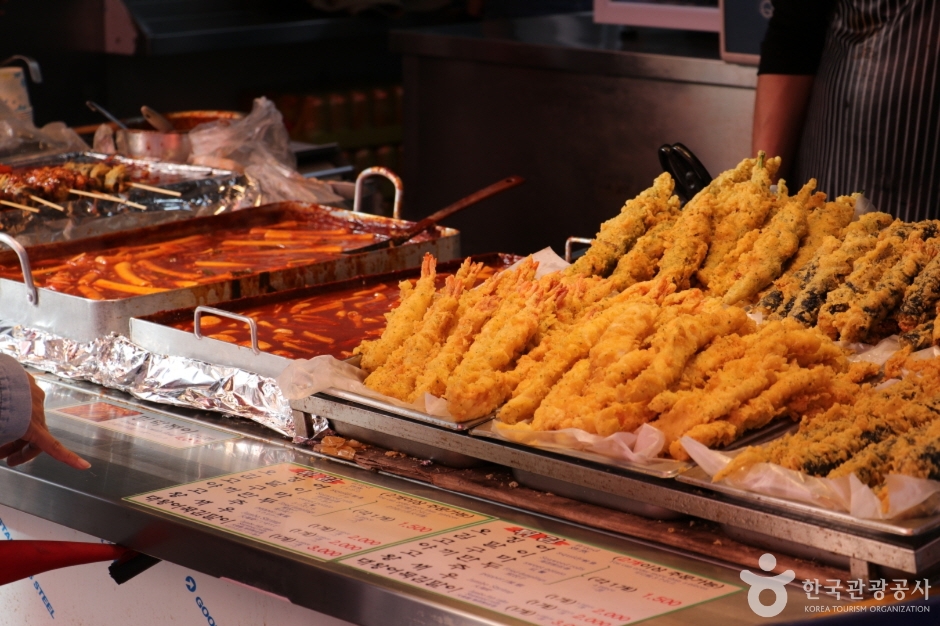
떡볶이 — tteokbokki. Rice cake in chilli sauce. The sauce base is commonly built on anchovy stock, and eomuk — fish cake — is usually in the pan with it. No pork by default, but not fish-free.
어묵 국물 — the free broth at fish-cake stalls. Anchovy and kelp. It is not a vegetable broth.
된장찌개, 미역국, most soups. Korean soup stock is overwhelmingly anchovy-and-kelp or beef. A soup can contain no visible meat and still be built on it. This is the single most common problem for vegetarian visitors.
김밥. The standard roll usually contains ham and imitation crab stick. Vegetable kimbap (야채김밥) is a real menu item — you have to ask for it by name.
라면. Instant ramyeon soup powder commonly contains beef or pork extract. The noodles are not the issue.
Where alcohol turns up
Cooking wine (맛술, 청주) is standard in Korean braises, marinades and stir-fries. It is used the way white wine is used in French cooking and is rarely mentioned on menus.
If you avoid alcohol entirely, this affects far more dishes than the drinks list — including many meat marinades and most braised dishes.
What varies by vendor, and what does not
Fixed: what a dish is. Jokbal is pig’s trotter everywhere. Sundae is intestine everywhere.
Variable: the stock, the frying oil, the seasoning. One tteokbokki stall uses anchovy stock, another uses a commercial powder. One hotteok vendor fries in vegetable oil, another may not. We cannot verify individual stalls, and neither can any other website.
So the honest structure is: know what the dish is by definition, then ask about the parts that vary.
The questions to ask
Short, and they work at a stall. Carry a transport card and you can reach any of the markets below for ₩1,550 or less.
| Korean | Roughly | |
|---|---|---|
| Is there pork in this? | 돼지고기 들어가요? | dwaeji-gogi deul-eo-gayo? |
| Is there meat in this? | 고기 들어가요? | gogi deul-eo-gayo? |
| Is there fish or seafood? | 생선이나 해물 들어가요? | saengseon-ina haemul deul-eo-gayo? |
| I don’t eat pork | 돼지고기 못 먹어요 | dwaeji-gogi mot meog-eoyo |
| Is this made with anchovy stock? | 멸치 육수예요? | myeolchi yuksu-yeyo? |
That last one is the useful one. Vendors understand it immediately, and it addresses the ingredient most likely to be invisible.
Note the phrasing 못 먹어요 — “I cannot eat” — rather than “I don’t like.” In Korean this reads as a restriction rather than a preference, and it is taken seriously.
Reasonably safe by definition
Not a guarantee, but these carry the fewest hidden animal ingredients:
- 붕어빵 / 계란빵 — flour, red bean, egg. Watch only the frying surface
- 군고구마, 군옥수수 — roasted sweet potato, roasted corn
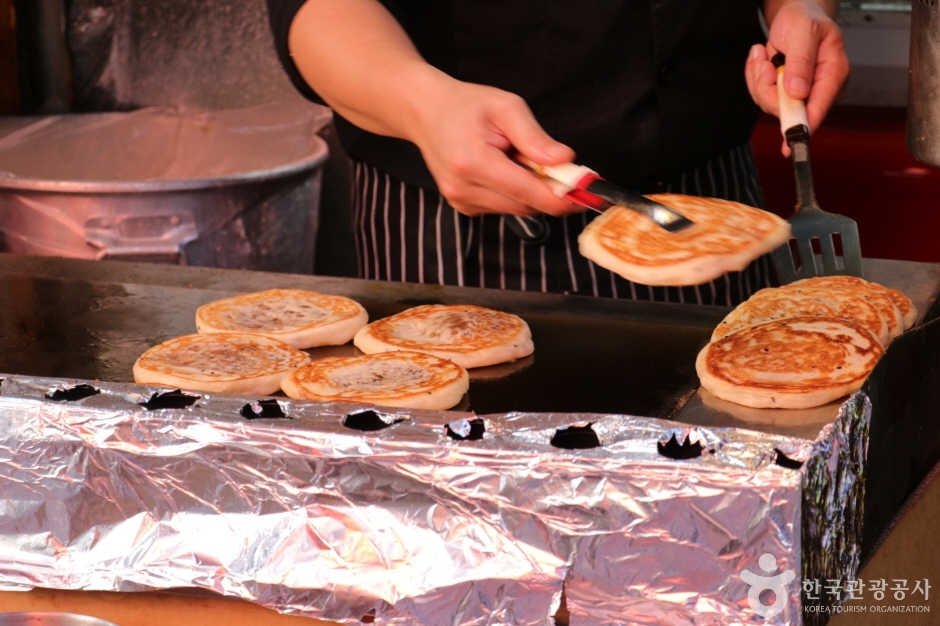
- 호떡 — dough and brown sugar filling; the frying fat is the variable
- 사찰음식 — temple cuisine, which excludes meat, fish and the five pungent vegetables by doctrine, not by preference. If you want certainty, this is the category built for it
What this article does not claim
We describe dishes as defined in Korean reference sources, and we are explicit about which elements vary between vendors. We have not tested any individual stall or restaurant, and we are not telling you that any specific food is permissible under your own religious or dietary rules — that is your determination to make, and this page is background for it.
We also do not certify anything as halal, and we want to correct something we previously wrote here.
The Korea Tourism Organization does publish an official Muslim-friendly restaurant classification, and it is live now. VisitKorea’s Muslim-friendly Travel section lists restaurants in four tiers — Halal Certified (by an accredited body such as the Korea Muslim Federation), Self-certified, Muslim Friendly (some halal dishes; alcohol may be served) and Pork-free (no halal menu, but no pork) — with pictograms for Muslim owner/chef, halal menu, alcohol-free and pork-free, and downloadable restaurant guides and maps.
Two cautions that matter more than the tiers. The most recent downloadable restaurant list is dated 2022, so individual entries may have closed or changed. And KTO notes that hotel restaurants and buffets in the “Muslim friendly” tier may still serve pork. Only the Halal Certified tier involves certification by an outside accrediting body; the rest are self-declared or descriptive. Confirm with the restaurant before you order.
If a restriction is strict, ask at the point of sale and treat this page as a list of things to ask about — not as clearance.
Read next
Sources & last checked
- Public institution · checked 2026-08-15 Muslim-friendly Travel — VISITKOREA, 한국관광공사 (restaurant categories, pictograms, e-books)
- Public institution · checked 2026-08-14 순대 — 한국민족문화대백과사전 (한국학중앙연구원)
- Public institution · checked 2026-08-14 병천순대 — 한국민족문화대백과사전 (한국학중앙연구원)
- Public institution · checked 2026-08-14 김장, 김치를 담그고 나누는 문화 — UNESCO 인류무형문화유산