HANKUKIN Scenes · When Life Gives You Tangerines
The Jeju Behind When Life Gives You Tangerines: Wind, Stone, Women
The Netflix series is set on an island that is not quite Korea — different landscape, different houses, different food, and a language mainland Koreans cannot follow. Even the title is a sentence most Koreans have to have translated. Here is what the island is made of, why it looks the way it does, and what to expect when you get there.
This article contains affiliate links, marked where they appear. If you book through one we may earn a commission at no extra cost to you — how this works.
This article contains affiliate links. We may earn a commission if you book or purchase through them, at no additional cost to you.
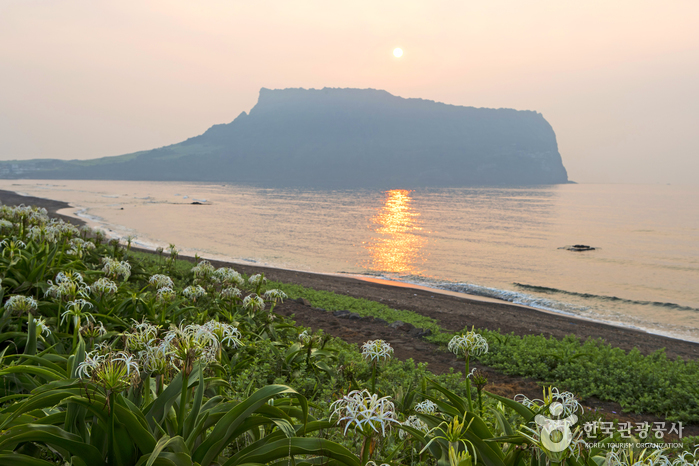
Why this scene matters
Start with the title, because the title is already the argument.
폭싹 속았수다 (pok-ssak sog-at-su-da). Netflix released it in English as When Life Gives You Tangerines, which is good localisation and tells you nothing. What it did not do is translate it, and there is a reason: the phrase is Jeju speech, and to a Korean reader from the mainland it looks like a sentence it is not. 속았수다 sits a syllable away from standard 속았습니다 — and in the standard dictionary, 속다 means to be deceived. Read it as mainland Korean and the title says you were thoroughly taken in. That is not what it says.
We are not going to hand you a gloss in quotation marks — see the last section for why. The shape of the thing is the point: the show is named in a variety of Korean that Korean speakers have to have explained to them. That is the island in one line, and everything below follows from it.
Netflix’s own synopsis is a single sentence — “In Jeju, a spirited girl and a steadfast boy’s island story blossoms into a lifelong tale of setbacks and triumphs.” The word doing the most work in it is the first one.
Three too many
Jeju’s own tourism board, run by the provincial government, opens its culture pages with a sentence worth holding on to for the rest of your trip.
제주는 육지(한국 본토)와 자연과 문화, 언어 등이 다르다. Jeju differs from the mainland in its nature, its culture and its language.
Jeju Tourism Organization, VisitJeju — culture, history and art 제주관광공사, 비짓제주 — 문화·역사·예술 20 August 2026
The island’s nickname is 삼다도 (sam-da-do), “the island of three abundances” — wind, stone and women. In English this usually arrives as a piece of tourist-brochure whimsy. It is not whimsy. Each of the three is a physical constraint, and you can still see what each one forced people to build.
The wind is the architect
The Rural Development Administration puts a number on it that no travel guide bothers with: on Jeju the wind blows at 10 m/s for roughly 117 days of the year. That is a gale-adjacent wind for a third of every year, on farmland, on an island in the path of typhoons.
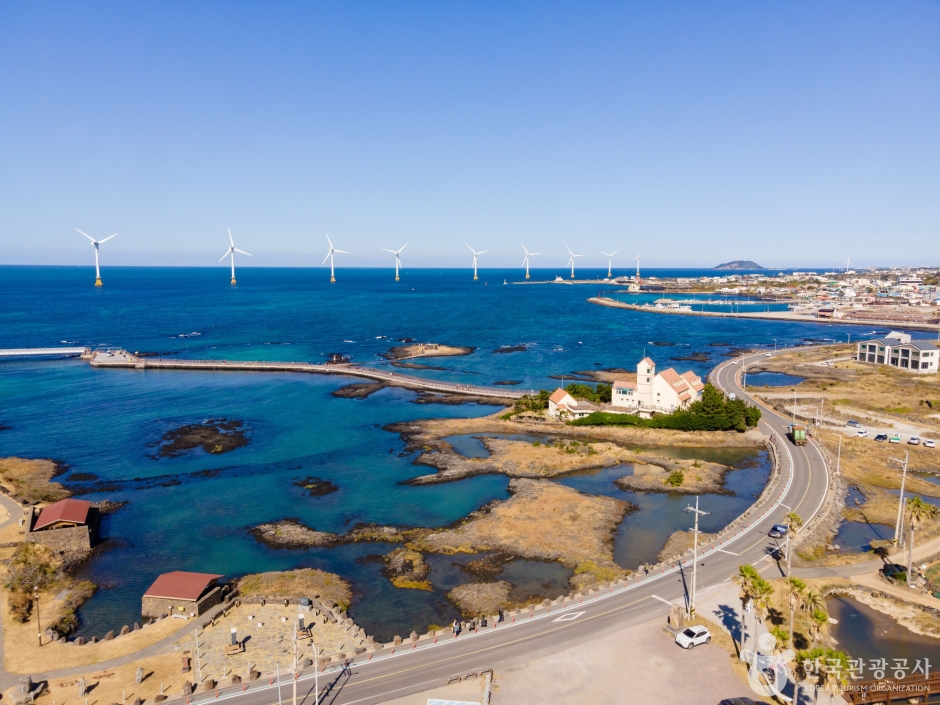
Everything domestic on Jeju is a reply to that.
The traditional house is not entered from the road. You come in along an 올레 (ol-le) — a private stone-walled lane that bends. VisitJeju is explicit that the bend is engineering, not landscaping: rough wind that comes down a curved, loosely stacked lane arrives at the house with the fight taken out of it, and the curve means nobody on the road can see in. (If the word looks familiar, it is: the island’s long-distance walking route, the Jeju Olle Trail, is named after it.)
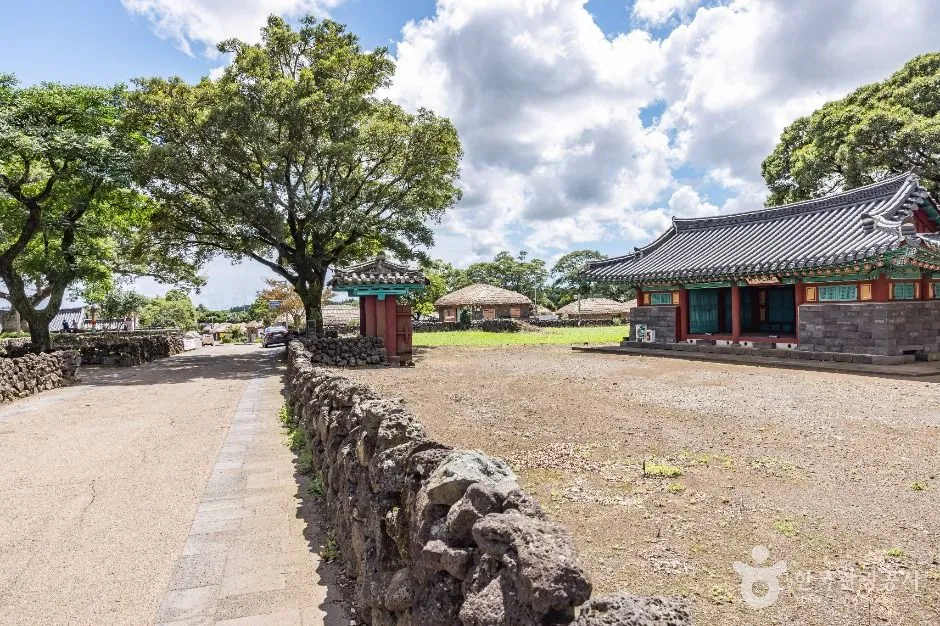
At the mouth of the lane there is no gate. There are three logs — 정낭 (jeong-nang) — resting in a pair of stone posts. They were there to stop the free-ranging horses and cattle wandering in, and they are logs rather than a door for the obvious local reason: wind goes through them, so a typhoon cannot take them off their hinges. They are also a message.
| Bars across the gap | What it tells a caller |
|---|---|
| Three | Out for the whole day |
| Two | Gone a good while |
| One | Back shortly |
A sign with no writing on it. You can still stand in front of one and read it.
The roof finishes the argument. Reed thatch, then thick rope thrown over the top in a grid — VisitJeju’s word for the pattern is 바둑판 (ba-duk-pan), a Go board — and lashed down. Stone wall outside, mud packed into it, rope net over the whole thing. Nothing about it is decorative.
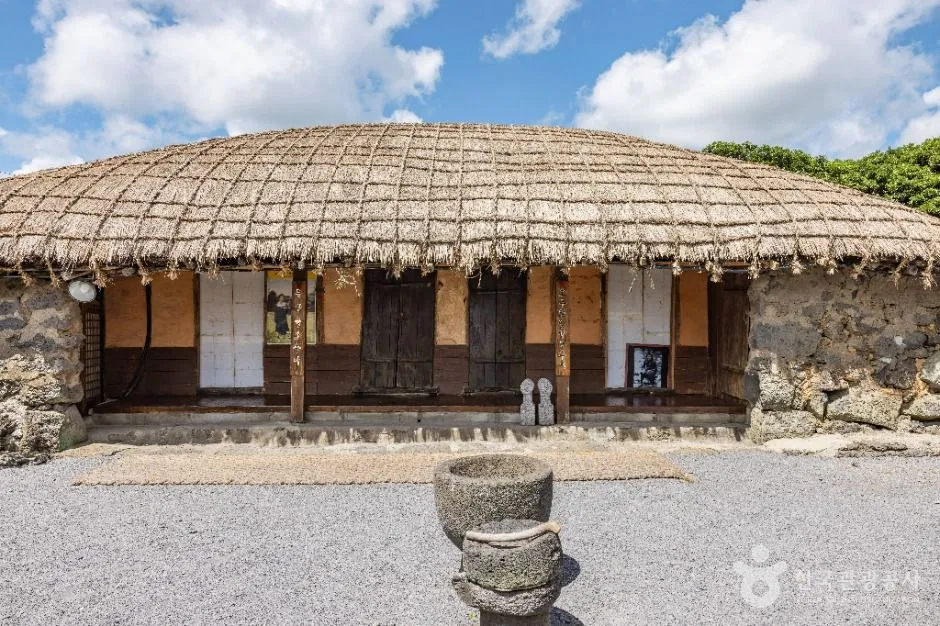
And one more thing, which is where the drama comes back in. A Jeju house has two dwellings around one yard: the 안거리 (an-geo-ri), the inner one, and the 밖거리 (bak-geo-ri), the outer one. When a son married, the parents kept the inner house and the couple took the outer one — each with its own kitchen, its own crocks, its own privy. Then, after a set period, they swapped. One family by address, two households by economy.
Now read Netflix’s summary of episode four: “Summer brings joy as the newlyweds start a life together, but living with Gwan-sik’s family tests their happiness — can they find a path to peace?” On the mainland that is a mother-in-law story. On Jeju it is a story about a specific building arrangement, and about who is currently entitled to hold the ancestral rites — because on Jeju that authority sits in the inner house and moves with the swap.
Twenty-two thousand kilometres of wall
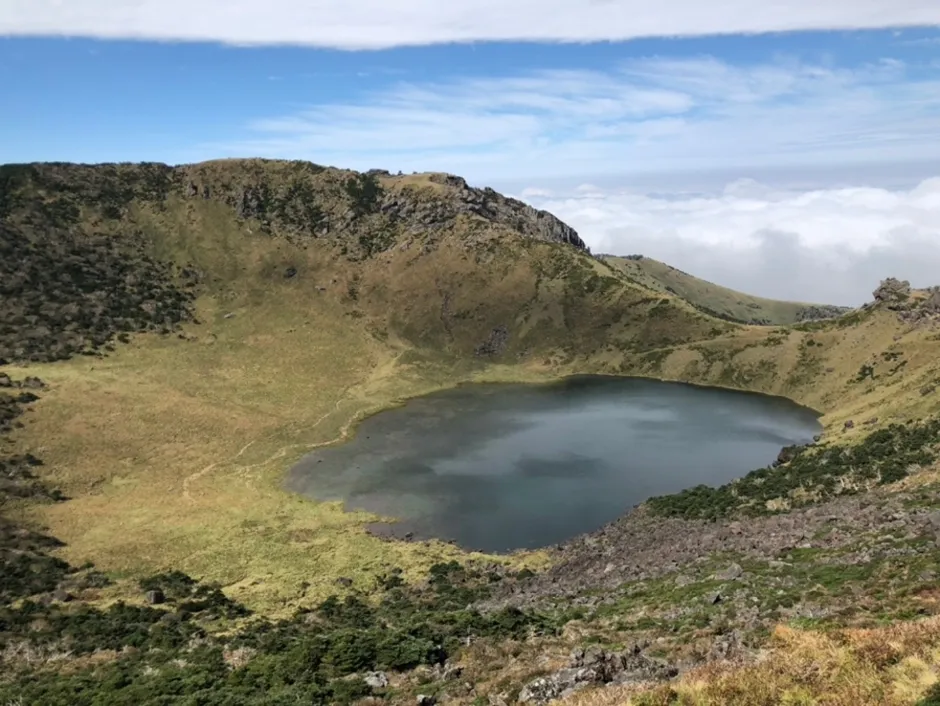
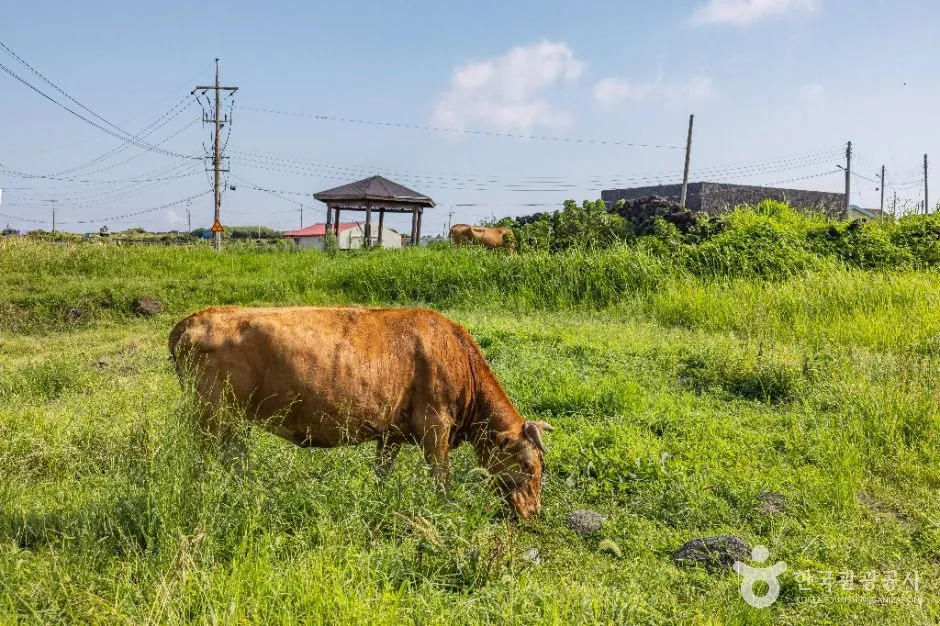
The second abundance is under your feet before you notice it. Jeju is basalt: the fields produce stones the way other fields produce weeds, and clearing them was endless. Carrying them away was pointless, so they were stacked at the edge — which also, conveniently, broke the wind and kept the cattle out. In 1234 a Jeju magistrate ordered boundary walls built so that the strong could not quietly take the land of the weak, and the practice spread across the island.
The total is the fact worth carrying: research quoted by the Rural Development Administration puts the length of Jeju’s field walls at 22,108 km. The earth is about 40,000 km around. Jeju calls them 흑룡만리 — said heung-nyong-mal-li, not heuk-ryong-man-ri, for the reason Jongno is not Jongro — the black dragon, ten thousand ri, because from a distance the basalt runs and coils. They are dry-stacked, no mortar, and that is deliberate too: when the wind takes a section out, the rest stays up and you rebuild only the gap.
They are listed as a FAO Globally Important Agricultural Heritage System, which is a strange and correct thing for a wall to be.
“Many women” is not a headcount
This is the one that travels badly, and it is worth getting right before you arrive and say something clumsy.
The province’s own account does not describe a sex ratio. It describes who did the work: the person diving, the person weeding the field, the person selling at the market, the person carrying the water and the firewood — all of them women, which is why the island got the name. And it notes something you can check in any local shrine: Jeju’s important gods are overwhelmingly goddesses — Seolmundae who made the island, Yeongdeung of the wind, Jacheongbi of the crops.
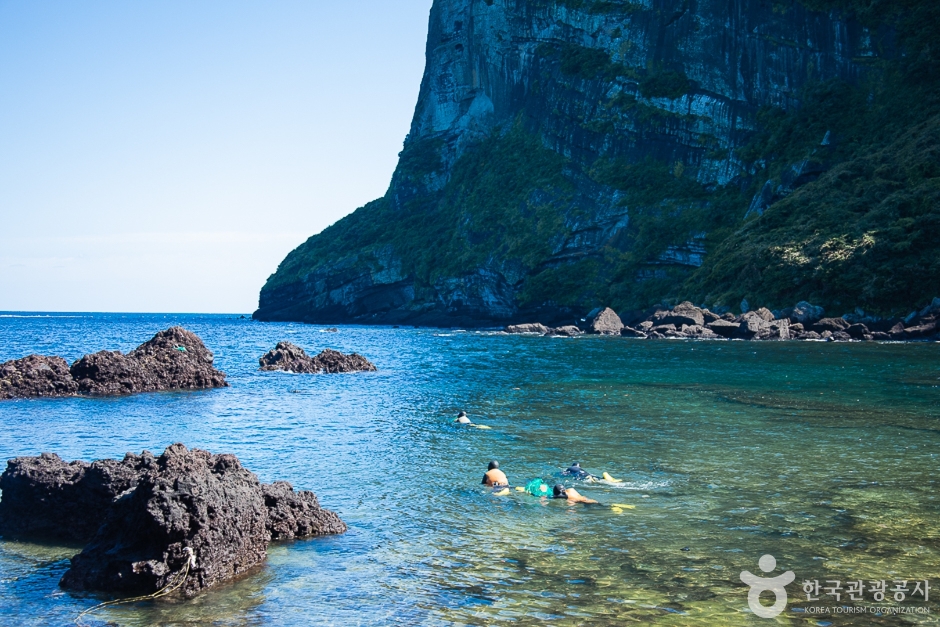
The clearest surviving version is the 해녀 (hae-nyeo), the diving women, inscribed by UNESCO in 2016. The inscription text is written in English and is not romantic about the job: a community of women, “some aged in their 80s,” going ten metres down without oxygen masks to gather abalone and sea urchin. Up to seven hours a day, ninety days a year, about a minute of held breath per dive, and a particular sounded exhalation on surfacing. Divers are ranked by experience — hagun, junggun, sanggun — and the seniors lead the others down.
Episode five of the series is called A Midsummer Night’s Full Nets. It is not a metaphor.
There was never a paddy field
Here is the fact that reorganises Jeju food for you: the island has no rice paddies. Volcanic ground will not hold standing water, so Jeju farmed dry fields, and the Rural Development Administration’s list of what grew instead reads like a different country’s pantry — barley, wheat, buckwheat, foxtail and proso millet, soy and adzuki beans, and a dryland rice grown without flooding.
That is why the island’s plainest everyday thing is 빙떡 (bing-tteok): a thin buckwheat crêpe rolled around seasoned white radish, austere to the point of blankness, and unlike anything sold on a mainland street.
Tangerines are the modern chapter. On the volcanic-ash soils the crops today are radish and 감귤 (gam-gyul), the tangerine; garlic and cabbage grow on the non-volcanic ground, carrots in the volcanic sand. The English title of the series picked the right fruit.
The bill for being an island
Almost everything on Jeju arrives by boat, and it shows up in the price of lunch. When we went through the Korea Consumer Agency’s June 2026 restaurant survey for our piece on what meals cost, two of the eight dishes had their national maximum on Jeju — kalguksu at ₩10,375 and jajangmyeon at ₩7,750, both above Seoul.
The second one is the tell. Jajangmyeon is the flattest-priced dish in the country: ₩6,769 to ₩7,750 nationwide, a 14% spread, the closest thing Korea has to a fixed price. Even that dish is at its ceiling on Jeju. Budget for it.
Whether you are allowed to drive here
Jeju is the one part of Korea where the honest advice is rent a car. The things worth seeing are spread around the coast and up into the middle, and the alternative is a trunk bus to a transfer stop and a branch bus after it. But whether you may drive is settled before you land, by a document you cannot obtain in Korea.
Korean law is specific, and it is more generous than most visitors assume. Under Article 96 of the Road Traffic Act, a permit issued abroad under either the 1949 Geneva Convention or the 1968 Vienna Convention lets you drive here — as does a foreign licence covered by a bilateral recognition agreement.
…국제운전면허증 또는 상호인정외국면허증을 발급받은 사람은 국내에 입국한 날부터 1년 동안 … 자동차 등을 운전할 수 있습니다 A person issued an international driving permit, or a mutually recognised foreign licence, may drive for one year from the day they entered the country.
Korean Ministry of Government Legislation, plain-language guide — Road Traffic Act art. 96(1) 법제처 찾기쉬운 생활법령정보 — 도로교통법 제96조제1항 20 August 2026
Four things follow, and each one catches somebody.
The clock runs from the day you entered Korea, not from the day the permit was issued. A permit issued eleven months ago is still good for a full year here. A permit issued last week does not buy you a year if you have already been in the country ten months.
It must be a real one. The road safety authority warns in as many words that documents from unofficial outfits are not valid, and gives you the tell: the genuine article is titled International Driving Permit. The fakes sold online say International Driving Licence. One word on the cover, and it is the difference between driving and driving unlicensed.
Your country has to be on a list. Between them the two conventions cover most of ours — the United States, Canada, the UK, Ireland, Australia, New Zealand, Japan, Singapore, France, Italy, Spain, the Netherlands, and Germany (Vienna, accepted in Korea since 1 January 2002). Mainland China is in neither convention, though permits issued in Hong Kong and Macau are recognised. Check the lists before you buy a flight, not after.
And a hire car is expressly allowed. Article 96(2) bars you from driving commercial vehicles on a foreign permit — but the same article carves out rental cars by name. That is the legal ground under “yes, you can pick one up at Jeju airport.”
If none of that works out, the island’s answer is not a bus timetable. The same rental companies run private charters with a driver from a desk inside the terminal, and there are English-language day tours that take in the UNESCO sites — Seongsan Ilchulbong, the columnar cliffs, the falls — in one go. We have opened and checked one of each, and they are at the foot of this article, along with the island’s hotel search. Those three links are the only commercial ones here, and we say so at the top of the page as well.
When to go
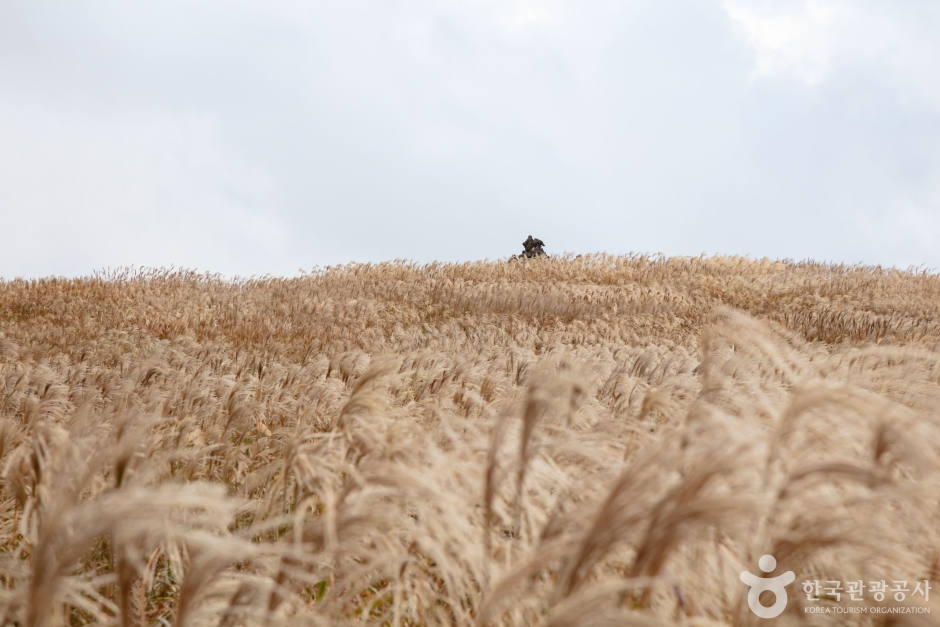
The series names its episodes for the seasons — Spring in a Heartbeat, The Blazing Summer Sunshine, A Fruitful Fall — and the island earns that structure. Two notes on top of our month-by-month calendar. VisitJeju describes the island as sitting in the path of the typhoons; that is the same wind that shaped the houses, and late summer is when it is most likely to cost you a ferry or a flight. And the tangerines the English title borrows are a late-autumn and winter crop, not a summer one — if you came for the fruit in the picture, you came in the wrong month.
One correction we owe you, because a reader would otherwise take the wrong impression from our own back catalogue. Jeju is not a warm-winter escape, and Hallasan gets serious snow. Our piece on where snow actually falls in Korea is built on the meteorological agency’s station figures for Mokpo, Seoul and Pohang — and it does not mention Jeju at all. That is a hole in it, not a verdict on the island. We have not yet opened the agency’s Jeju figures, so we are not going to put a number here; when we have them, that article gets Jeju and this line gets a link.
Four things we did not do
Everything above is from the production’s own page or from a government or UNESCO source, read on 20 August 2026.
We did not gloss the title. We could not open a provincial dictionary entry for the Jeju verb behind 속았수다, and a phrase in an endangered language is not something to approximate for effect. We did not say where the series was filmed — Netflix says it is set on Jeju; shooting locations we could not confirm, and we do not publish location claims we cannot stand behind. We did not print the rental counter’s rules — the law above is the law, but minimum age, months held and whether a credit card in your own name is required are each company’s own policy, and we have not checked them one by one. And we barely touched the language, which deserves its own piece: it keeps a vowel standard Korean lost, and it marks ongoing action with an ending standard Korean does not have. That one is next, and we will open the dictionaries for it.
Related
- What eight everyday Korean meals cost, by region — where the Jeju figures above come from
- Best time to visit Korea, month by month — including the typhoon window
- Geoje Island: a castle one man built — the other Korean island we have written up
- Every problem we cover, with one-line answers
Visit Korea
Trip.com · Affiliate link — we may earn a commission→Jeju private car charter with a driver — LOTTE rent-a-car, on Klook
Klook · Affiliate link — we may earn a commission→Jeju UNESCO sites day tour, English-only small group — on Klook
Klook · Affiliate link — we may earn a commission→
Every link above is an affiliate link: if you book through one we may earn a commission, at no extra cost to you. We were not paid to write any of this and nobody reviewed it before publication but us.
Read next
Sources & last checked
- Official — production · checked 2026-08-20 When Life Gives You Tangerines — Netflix official title page (year, format, cast, creators, episode synopses)
- Public institution · checked 2026-08-20 삼다도 — 비짓제주, 제주관광공사 (VisitJeju, Jeju Tourism Organization: the three abundances)
- Public institution · checked 2026-08-20 의식주 — 비짓제주, 제주관광공사 (VisitJeju: Jeju food, dress and dwelling — olle, jeongnang, thatch, angeori and bakgeori)
- Public institution · checked 2026-08-20 국가중요농업유산 제2호 제주밭담 — 농촌진흥청 웹진 (Rural Development Administration: Jeju field walls, wind, and what grows without paddies)
- Public institution · checked 2026-08-20 Culture of Jeju Haenyeo (women divers) — UNESCO Representative List of the Intangible Cultural Heritage of Humanity, inscribed 2016
- Public institution · checked 2026-08-20 표준국어대사전 — 국립국어원 (Standard Korean Dictionary: the standard-Korean sense of 속다, 'to be deceived')
- Public institution · checked 2026-08-20 외국의 국제운전면허증으로 대한민국에서 운전하려 합니다 — 법제처 찾기쉬운 생활법령정보 (Road Traffic Act art. 96: driving in Korea on a foreign permit, with the Geneva and Vienna country lists)
- Public institution · checked 2026-08-20 국제운전면허증 안내 — 한국도로교통공단 안전운전 통합민원 (KoROAD: valid permits, unofficial imitations, Vienna accepted from 2002, Hong Kong and Macau)