HANKUKIN Scenes · RESCENE
Geoje Island: The Windy Hill, a Castle One Man Built, and Yi Sun-sin's First Win
Geoje is Korea's second-largest island and most foreign visitors have never heard of it. It has a grass headland over turquoise water, a stone castle a single farmer built by hand after a typhoon, and the bay where Admiral Yi Sun-sin won his first battle in 1592. It is an hour from Busan, about five from Seoul, and almost entirely domestic.
This article contains affiliate links, marked where they appear. If you book through one we may earn a commission at no extra cost to you — how this works.
This article contains affiliate links. We may earn a commission if you book or purchase through them, at no additional cost to you.
Why this scene matters
There is a reason a lot of Koreans suddenly learned to say “거제 야호” this year, and it is worth explaining before we get to the island.
In February 2026 the leader of the girl group RESCENE, WONYI, opened a personal YouTube channel. The clips that spread were built around her own accent — she is from Okpo, on Geoje island, and she used the local speech rather than smoothing it out. She has called herself the first idol to come from Geoje, and she promoted the place relentlessly. Six months later a song of theirs from 2024 was number one on Melon. The chart side of that story is here.
This page is about the island, which was worth visiting before any of that happened.
Where Geoje actually is
Geoje is Korea’s second-largest island after Jeju, off the south coast in South Gyeongsang province. It is not remote: it is joined to the mainland by bridge, sits next to Busan, and its economy is shipbuilding rather than tourism — two of the world’s largest shipyards are there, one of them at Okpo.
That last fact shapes the visit. Geoje is a working island, not a resort. The coastline is spectacular and the towns are industrial, and Korean visitors accept that trade without thinking about it.
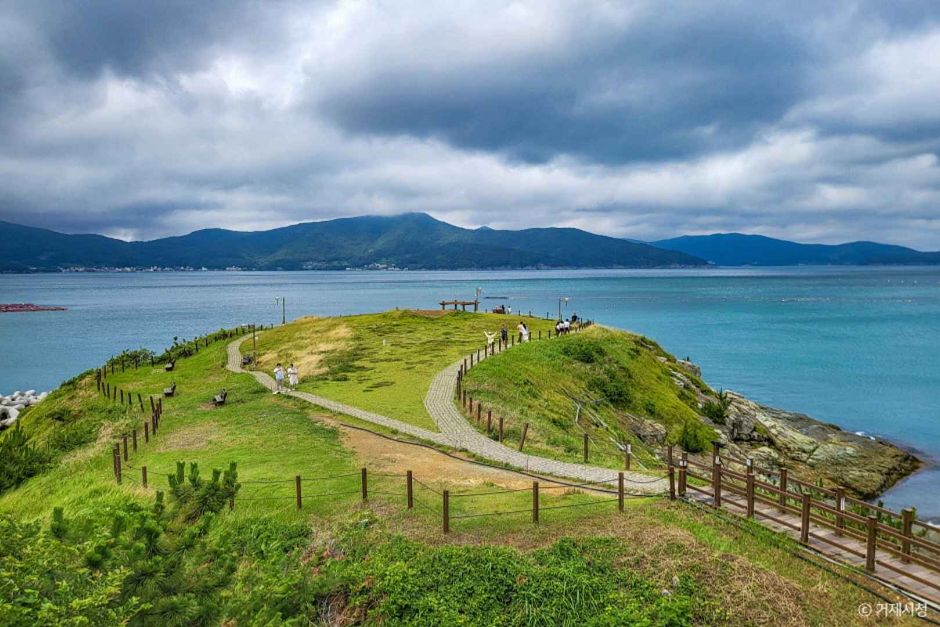
Windy Hill (바람의 언덕)
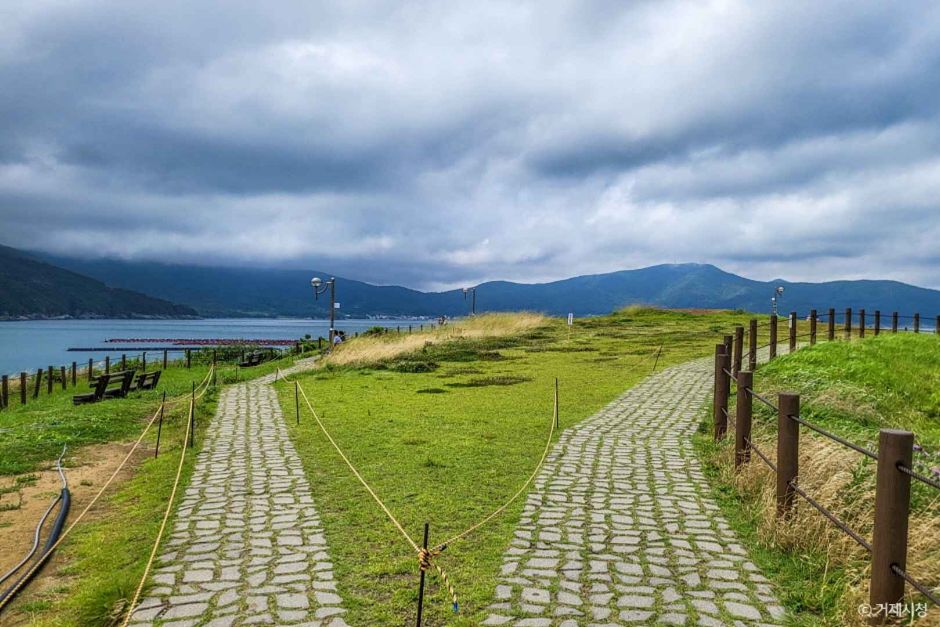
A bare grass headland at Dojangpo, on the south-east of the island, dropping to the sea on three sides.
There is no building on it and no admission. You walk up a short paved path from the village, and the hill does the rest — open grass, wind, and water that is genuinely turquoise on a clear day rather than the grey most Korean coasts offer.
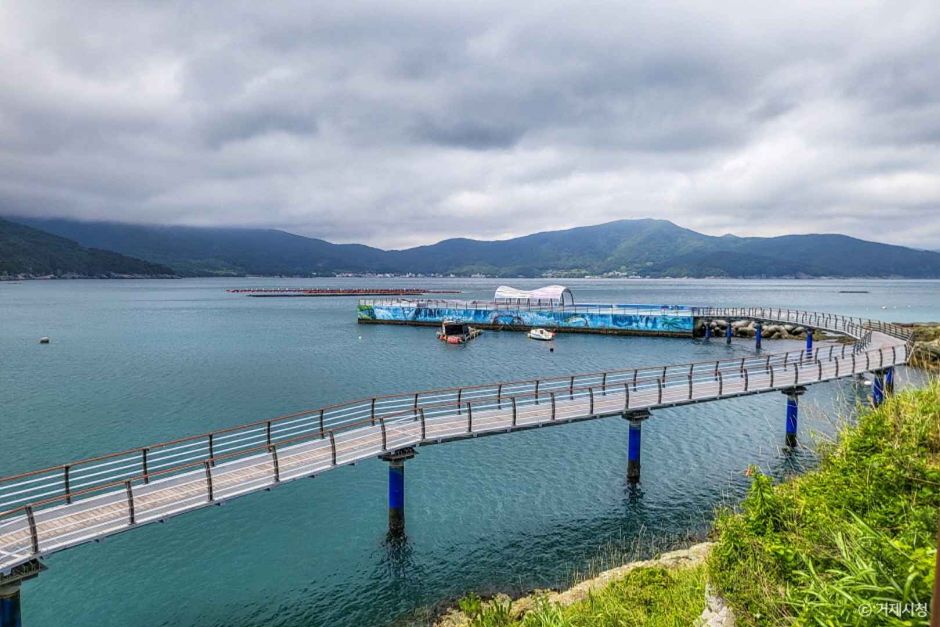
It is the single most photographed spot on Geoje and it takes about twenty minutes. Combine it with the boat to Oedo Botania, a garden island, which leaves from the same area.
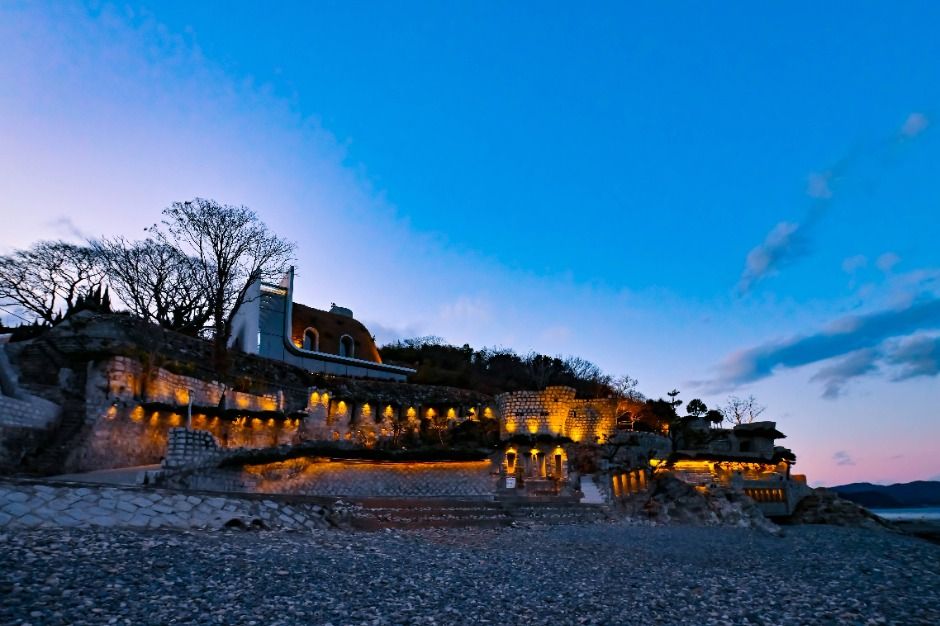
Maemiseong (매미성) — the castle one man built
This is the thing on Geoje you will remember, and it is not old.
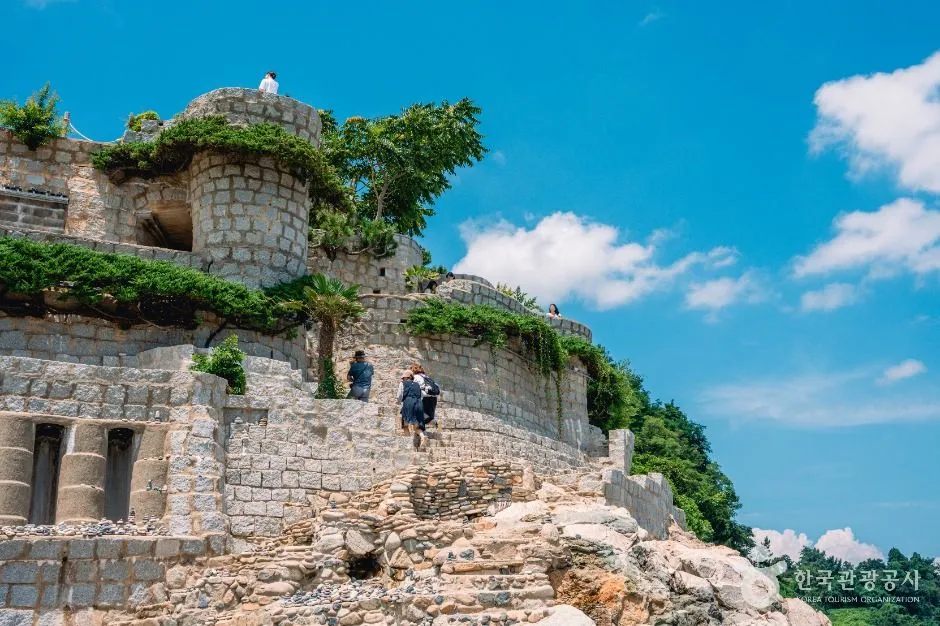
In 2003, Typhoon Maemi — one of the most destructive storms in Korean records — tore through the south coast. A farmer on Geoje lost his crops to the sea, and he began building a stone wall to hold the water back. He kept building. What stands now is a substantial stone castle of terraces, arches and battlements on the shoreline, made by one man over years, without a plan or a construction permit.
It is named after the typhoon that caused it. Admission is free, because it is not an attraction — it is a wall that got out of hand and became one.
Go for the story rather than the scale. Standing on it, the interesting thing is not that it looks medieval; it is that every stone was carried there by a person who was, at the start, only trying to protect a field.
Okpo (옥포) — where Yi Sun-sin won his first battle
Okpo is the shipbuilding town WONYI is from, and it is also one of the most consequential place names in Korean history.
In 1592, at the start of the Japanese invasion, Admiral Yi Sun-sin fought his first naval engagement in Okpo bay and won it — destroying a large part of the Japanese fleet anchored there and losing no ships of his own. It was the first Korean victory of the war, at a point when the land campaign was collapsing, and it began the run of naval victories that Yi is remembered for.
The Okpo Great Victory Commemorative Park (옥포대첩기념공원) sits above the bay, with an exhibition hall covering the battle and the ships.
Two things make this worth an hour even if you are not interested in military history. The first is that the bay you are looking at is still full of ships — enormous ones, under construction, in the same water. The second is that Korea’s most revered historical figure started here, at a place most visitors have never heard of.
Getting there
Take the train to Busan, then cross the bridge. Geoje has no railway station, so the fast route is rail to Busan and road for the last hour.
Straight from Incheon Airport
- AREX all-stop, Incheon Airport → Seoul Station. About an hour, ₩4,750. (Full airport comparison.)
- KTX, Seoul Station → Busan. About 2h30, ₩54,400 from 1 September 2026 — a figure Korail has published, not an estimate. (Why it changed.)
- Busan → Geoje across the Geoga Bridge, about an hour by intercity bus from Busan’s Sasang or Nopo terminals.
That is roughly five hours door to door, which makes Geoje an overnight rather than a day trip from Seoul — and a very easy day trip from Busan.
The alternative worth knowing
Direct express buses run from Seoul to Geoje, taking considerably longer than the train-plus-bus route. If you are already in Busan, forget all of the above: Geoje is an hour away and Koreans treat it as a Busan day out.
On the island
Geoje is large and the sights are strung along the coast rather than clustered. Buses run but are infrequent between villages, and Windy Hill, Maemiseong and Okpo are in three different directions.
Be honest with yourself about this before you go. If you have a driver’s licence and an international permit, hire a car. If not, plan two of the three sites, not all three, or budget for taxis. Trying to do the whole island by public bus in one day is how a Geoje trip goes wrong.
What each season gives you
The south coast is a different climate from Seoul, and Geoje’s calendar runs on it.
Winter into early spring (December–March) — camellia. The south coast is Korea’s camellia country, and Geoje’s offshore island Jisimdo is known for it; the flowers open through the cold months, which is the opposite of everywhere else. The island is also the mildest place on this page in January.
Spring (April–May) — the best all-round window. Windy Hill is green, the sea is clear, and the humidity has not arrived.
Summer (July–August) — beaches and boats, and the reason Koreans come. It is also the peak of domestic holidays, so the coast is full and prices rise. Hot and humid. (How hot it gets.)
Autumn (September–October) — the second good window: clear air, the best visibility of the year over the water, and the crowds gone.
If you are choosing on looks alone: late April, or October. If you are choosing on difference from home: January, for camellia in the cold.
What to eat
Geoje is a fishing and shipbuilding island, and the food follows the water.
Raw fish (회, hoe) is the local meal, eaten at harbour-side places and priced by the fish and the size of the plate rather than by the head. This is the one item on the island where you should ask the price before ordering — it varies enormously and it is the most common way visitors are surprised by a bill.
멍게비빔밥 (sea-squirt bibimbap) and grilled fish sets are the reliable, priceable options.
Busan is an hour away and is the milmyeon capital — the cold wheat-noodle dish that Busan invented. If you are routing through, eat there.
What a meal costs, by kind of restaurant
The Korea Consumer Agency surveys the same dishes in every province every month, so the Korean-food and Chinese-food numbers below are measured rather than guessed. The rest are marked Approximate.
| Kind | Typical one-person cost | Source |
|---|---|---|
| 분식 · snack bar (gimbap, tteokbokki, ramyeon) | ₩4,000 – 9,000 | gimbap ₩3,838 surveyed |
| 중식 · Korean-Chinese (jajangmyeon, jjamppong) | ₩7,000 – 12,000 | jajangmyeon ₩6,769–7,750 surveyed |
| 한식 · sit-down Korean (stew set, bibimbap, ssambap) | ₩9,000 – 14,000 | kimchi jjigae set ₩8,654 · bibimbap ₩11,769 surveyed |
| 한식 · grilled meat, per person at a table | ₩20,000 – 30,000 | samgyeopsal ₩21,321 / 200g surveyed |
| 일식 · Japanese (donkatsu, sushi) | ₩10,000 – 25,000 | Approximate |
| 치킨 · fried chicken, whole bird to share | ₩20,000 – 26,000 | Approximate |
| 피자 · delivery, medium | ₩20,000 – 35,000 | Approximate |
| Café coffee | ₩4,500 – 6,500 | Approximate |
The useful shortcut: one sit-down Korean meal ≈ ₩10,000. Two of those plus a coffee is an ordinary day. Grilled meat and fried chicken are the two items that break a budget, and both are social dishes ordered for a table rather than a person. (The full national price table by province.)
If you stay the night
Stay near Gohyeon (the main town, where buses arrive) if you are without a car, or near Dojangpo / Windy Hill if you are driving and want the coast.
On price, we are giving a range and telling you why. We have not surveyed properties on Geoje and will not recommend one we cannot check. As an anchor: the Consumer Agency puts a plain budget inn (여관) at ₩53,769 in Seoul, and Seoul is the country’s most expensive market.
| Realistic range, per room per night | |
|---|---|
| Guesthouse dorm bed | ₩25,000 – 40,000 |
| Budget inn / motel | ₩40,000 – 70,000 |
| Mid-range hotel | ₩90,000 – 160,000 |
| Sea-view resort | ₩150,000 – 350,000 |
Geoje is a domestic summer destination, so July and August sit at the top of every band and book out. In April or October you will pay the bottom.
We link a search, not a property. The table above is as far as our own checking goes, so the link below opens Geoje on Trip.com rather than pointing at one hotel. Decide the area first — Gohyeon if you are on buses, the coast if you are driving — then filter. We are handing you the search, not the answer.
What it costs: one person, one night
| Amount | Where it comes from | |
|---|---|---|
| Airport → Seoul Station (AREX) | ₩4,750 | AREX published fare |
| Seoul → Busan, KTX | ₩54,400 | Korail published fare |
| Busan → Geoje, intercity bus | ₩7,000 – 12,000 | estimate — not verified |
| Geoje → Busan → Seoul, return | ₩61,400 – 66,400 | as above |
| Taxis or car hire on the island | ₩20,000 – 90,000 | wide, because it depends entirely on driving |
| Admissions (Windy Hill, Maemiseong) | ₩0 | open outdoor sites |
| Food, two days | ₩30,000 – 45,000 | Consumer Agency averages; raw fish can exceed this |
| One night’s accommodation | ₩40,000 – 90,000 | range, mid of the table above |
| Total, one person | ≈ ₩220,000 – 350,000 | ≈ US$160–255 |
The spread is wider than Gyeongju’s, and the reason is transport on the island. If you drive, the low end is realistic. If you rely on taxis between three coastal sites, you reach the high end quickly. This single decision is worth more than everything else in the table.
Take ₩60,000 off if you are starting from Busan rather than Seoul — which, if you can arrange it, is the better way to do Geoje anyway.
Related
- How a Korean song hit No.1 two years after release — the RESCENE chart run, with search data
- Gyeongju at night — the other Silla-era city in this series
- Best time to visit Korea
What this article does not claim
Four rows in the food table are marked Approximate. The Korea Consumer Agency’s national survey covers gimbap, jajangmyeon, kimchi jjigae, bibimbap, naengmyeon and samgyeopsal — those figures are measured. Japanese food, fried chicken, pizza and café coffee are not in that survey, and the ranges we give for them are ordinary menu prices rather than published data.
The cost table is a budget, not a quotation. Two lines are verified published fares (AREX ₩4,750, Korail ₩54,400). The Busan–Geoje bus fare is an estimate we have not verified, and it is labelled as one. Accommodation and island transport are ranges because we have not surveyed properties or priced car hire.
Camellia on Jisimdo and the winter flowering season are the reported pattern, widely described in Korean tourism material. We have not sourced a bloom calendar and flowering moves with the weather.
Raw fish prices are deliberately absent from the table. They vary by fish, size and season more than any other item, and quoting a figure would be misleading. Ask before ordering.
We have not verified admission, opening hours or transport timetables for any site on this page, and we have deliberately not invented them. Windy Hill and Maemiseong are open outdoor sites with no admission as far as we can establish; Oedo Botania and the Okpo park charge, and we do not have current figures. Check with Geoje city tourism before you build a schedule.
The Maemiseong account is the widely reported one. That a Geoje resident began building the wall after Typhoon Maemi in 2003 and continued for years is the standard telling in Korean media and tourism material. We have not sourced it from a primary document or spoken to anyone involved, and details such as exact dates and dimensions should be treated as approximate.
The Okpo battle summary is the conventional account of the first engagement of the Imjin War in 1592. We have not consulted primary records for ship counts, and different sources give different figures; we have therefore described the outcome rather than quoting numbers.
WONYI’s connection to Geoje is a hometown and a stated affection for it. She is from Okpo and has spoken publicly about promoting the place. Nothing here is a location she endorses commercially, a place she has appeared at for a brand, or a claim about where any video was filmed — and we are not implying any of those.
We have not been to Geoje. This is assembled from Korean media reporting and from Korea Tourism Organization photographs published under an open licence.
Visit Korea
Trip.com · Affiliate link — we may earn a commission→Geoje and Tongyeong day tour from Busan — Klook
Klook · Affiliate link — we may earn a commission→
Every link above is an affiliate link: if you book through one we may earn a commission, at no extra cost to you. We were not paid to write any of this and nobody reviewed it before publication but us.
Read next
Sources & last checked
- Media · checked 2026-08-15 '거제 야-호!' 열풍, 리센느 원이가 뜬 이유 — 하퍼스 바자 코리아
- Media · checked 2026-08-15 거제의 딸 리센느 원이, 장원급제급 금의환향 — KNN