HANKUKIN Scenes · RESCENE
Gyeongju at Night: Where the Silla Capital Still Lights Up
Gyeongju was Korea's capital for nearly a thousand years, and the strange thing about visiting it is that the best hours are the last ones. The royal pond stays open until 22:00, the observatory and the bridge are lit, and the crowds that fill the site at noon are gone. Here is what to see, when the light turns on, and what it costs.
This article contains affiliate links, marked where they appear. If you book through one we may earn a commission at no extra cost to you — how this works.
This article contains affiliate links. We may earn a commission if you book or purchase through them, at no additional cost to you.
Why this scene matters
If you have arrived here from a K-pop video, here is the connection, stated plainly and then set aside: ZENA of RESCENE is from Gyeongju, which is why Korean fans call her the Silla princess (신라공주) — Gyeongju was the capital of the Silla kingdom, and people from there get called that.
That is the whole of the fandom link, and it is not the reason to go. The reason to go is that Gyeongju is a city where a thousand years of capital is lying around in a field, and almost nobody outside Korea plans a night there.
The thing nobody tells you: go in the evening
Gyeongju is usually sold as a daytime itinerary — temples, tombs, museums, a bus timetable. That is a mistake, and the schedule proves it.
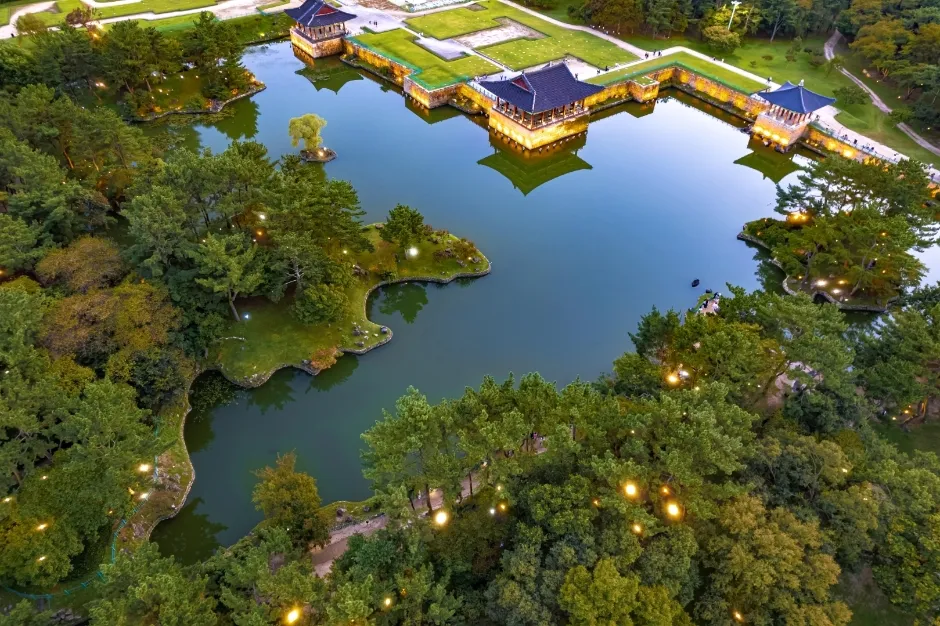
Donggung Palace and Wolji Pond stay open until 22:00, every day of the year. Korean heritage sites almost never do that. Gyeongju’s core sites are floodlit after dark and the city leans into it, and the practical effect is that the two best hours of a Gyeongju day are the two after sunset — when the tour buses have gone and the water is holding the light.
The three sites, and what each one is
Donggung and Wolji (동궁과 월지) — the crown prince’s palace and its artificial pond. Silla royalty held banquets here; when the pond was drained in the 1970s, tens of thousands of objects came out of the mud, which is why the nearby museum is unusually good. Open 09:00–22:00 daily, last tickets 21:30, adult admission ₩3,000. Allow about an hour. Arrive 30–60 minutes before sunset and you get the dusk and the lit reflection in one visit.
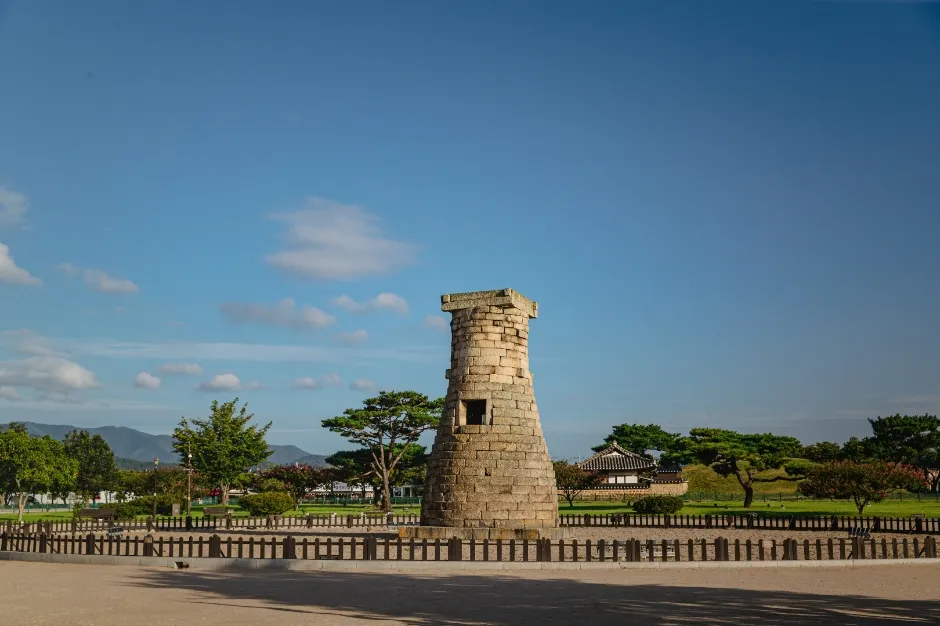
Cheomseongdae (첨성대) — a squat stone tower in an open field, built in the seventh century during the reign of Queen Seondeok, and generally described as the oldest surviving astronomical observatory in East Asia. It is 9 metres of cut granite that has been standing, outdoors, for roughly fourteen hundred years. It is lit at night and it sits in open parkland you can walk through.
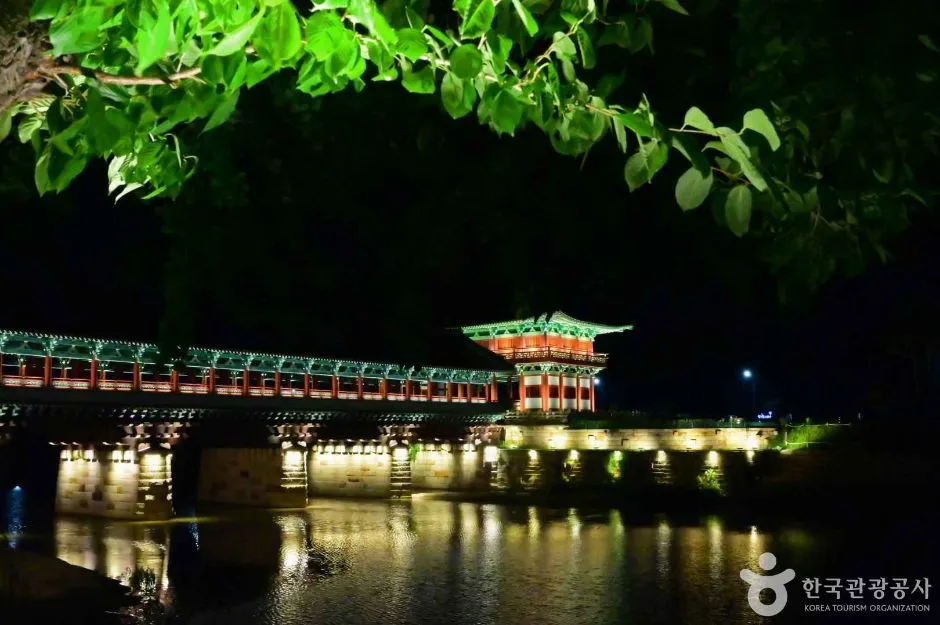
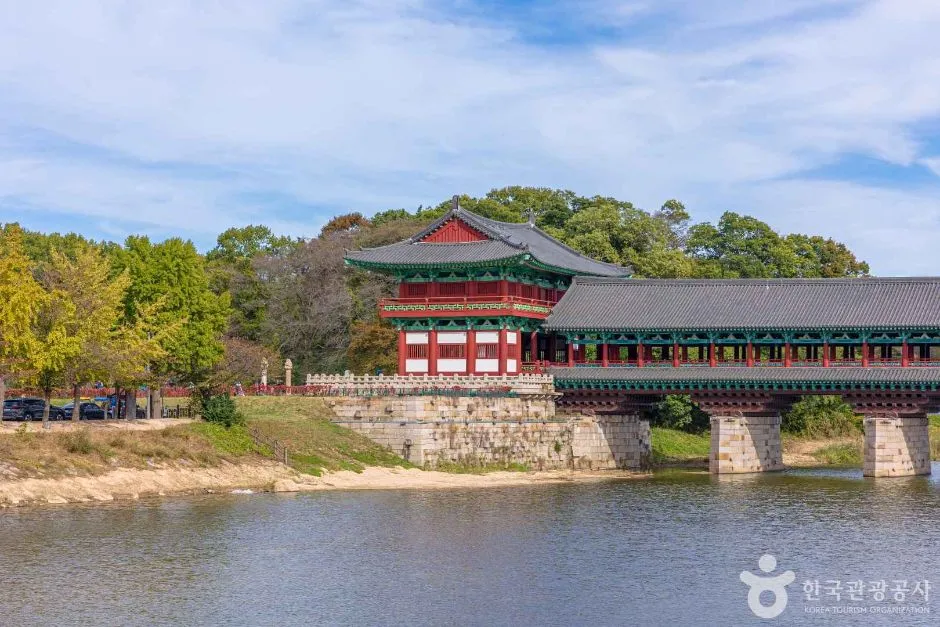
Woljeonggyo (월정교) — a covered wooden bridge over the Namcheon, first built in 760, connecting the palace fortress of Wolseong to the south of the city. What stands now is a reconstruction. It is the single most photographed thing in Gyeongju after dark.
All three sit within the Gyeongju Historic Areas, inscribed on the UNESCO World Heritage list, and all three are close enough to walk between.
The day version, if you only have daylight
The night argument does not mean the daytime is wasted. It means the daytime is for the things that close.
Morning — Bulguksa temple and Seokguram grotto, both UNESCO-listed, both outside the city centre and both on their own schedules.
Afternoon — the tomb mounds. Gyeongju’s royal tombs are grass hills the size of small buildings, sitting in the middle of the modern town, and one of them is open so you can walk inside. This is the single strangest thing about the city: the dead kings are in the street plan.
Late afternoon — the Hwangnidan-gil area, a strip of converted old houses now full of cafés and shops, which is where Gyeongju’s own visitors spend money.
Then the evening sites above. In that order, nothing closes on you.
Getting there
Take the train. This is not a preference, it is the shape of the country: Korea’s high-speed network reaches Gyeongju in about two hours from Seoul, and the bus does not compete.
Straight from Incheon Airport
There is no high-speed line from the airport itself. The route everyone actually uses is airport → Seoul Station → Gyeongju, and it works in one move:
- AREX all-stop train, Incheon Airport T1/T2 → Seoul Station. About an hour, ₩4,750. The express costs more and saves little. (The full airport-to-Seoul comparison is here.)
- KTX, Seoul Station → Singyeongju. About two hours.
- Singyeongju → the historic centre, about 20–30 minutes by local bus or taxi. The station is outside town, which surprises people.
Realistically that is four hours door to door, so if you land in the morning you can be at the pond by dusk. If you land in the evening, sleep near the airport or in Seoul and go the next morning.
From Seoul
KTX from Seoul Station to Singyeongju, roughly 2 hours, around 31 trains a day, first departure just after 05:00.
Budget ₩54,400 each way. That is Korail’s published Seoul–Busan fare from 1 September 2026, and Singyeongju is one stop short of Busan on the same line — so the real Gyeongju fare is a little lower. We are quoting the Busan figure deliberately: we would rather your budget be slightly too big than slightly too small. (Why the fare changed on 1 September.)
Gyeongju is a poor day trip and a very good overnight. The last train back leaves before the lights are at their best, which defeats the entire argument of this page.
A route that works, in one day and one night
Built around the one thing that is fixed: the pond closes at 22:00 and nothing else does anything special after dark.
| Day 1 · 14:00 | Arrive Singyeongju, drop bags | |
| 15:00 | Daereungwon tomb mounds — grass hills in the middle of town | |
| 16:30 | Hwangnidan-gil — coffee, old houses, this is where locals are | |
| 18:00 | Cheomseongdae as the light goes | walk |
| 19:00 | Donggung and Wolji — dusk and the lit reflection in one visit | ₩3,000 |
| 21:00 | Woljeonggyo — the bridge is at its best last | walk |
| Day 2 · 09:00 | Bulguksa temple, then Seokguram grotto above it | bus |
| 13:00 | Lunch, then train |
The three evening sites are within walking distance of each other. That is the whole reason this order works — you are not paying for taxis between them, and you catch each one as its light arrives.
What each season actually gives you
Gyeongju is one of the few Korean cities where the same three sites look like four different places across the year. This is worth choosing on.
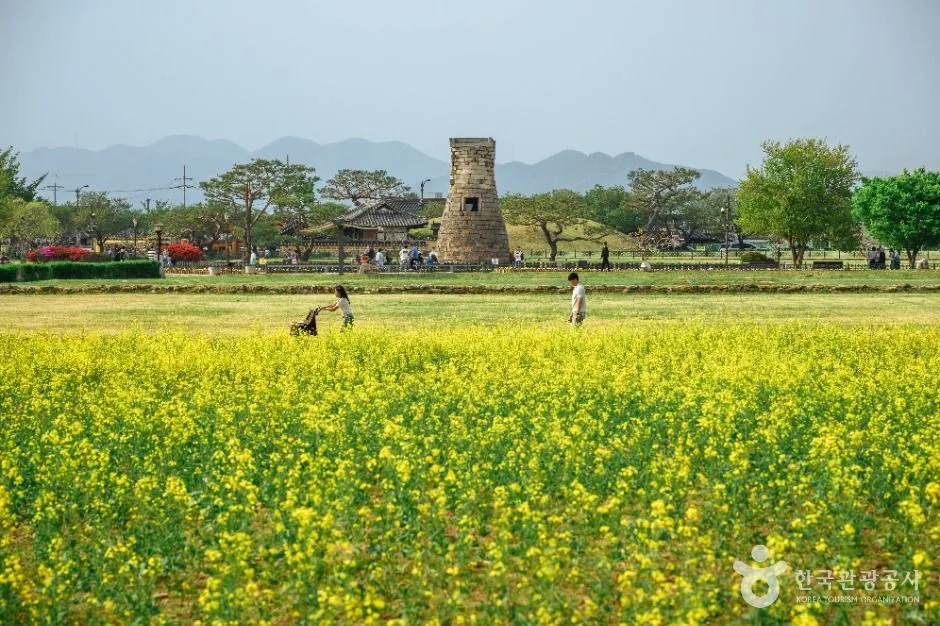
Spring (April–May) — the fields around Cheomseongdae are planted with rapeseed, and the tower stands in a sheet of yellow. This is the single most photographed version of Gyeongju and it lasts a few weeks.
Summer (July–August) — the lotus at Wolji. The pond’s lotus flowers peak in midsummer, and the site’s 22:00 closing means you get flowers by day and reflections by night in one ticket. It is also hot and humid; plan the day inverted. (How hot it gets.)
Autumn (late October–mid November) — colour reaches this part of the country late. Gayasan, the nearest of the four famous foliage mountains, peaks around the second week of November — so Gyeongju’s autumn runs behind Seoul’s, and a November trip that is too late for the capital can be exactly right here. (The foliage sweep.)
Winter (December–February) — the version almost no visitor sees. Gyeongju is inland and cold, the fields are bare, and the monuments stand in an empty landscape. Snow is not reliable this far south-east — Pohang, an hour away on the coast, recorded zero centimetres last winter. Come for the emptiness, not for snow. (Where the snow actually falls.)
If you are choosing purely on looks: late April or the first half of November.
What to eat
Gyeongju’s food is North Gyeongsang cooking, and provincial prices are genuinely lower than Seoul’s — the Korea Consumer Agency surveys the same dishes in every province, so this is measurable rather than folklore.
A proper sit-down lunch is about ₩9,000. A kimchi jjigae set — stew, rice and side dishes — averages ₩8,654 in Seoul and less in most provinces. That is the number to hold for an ordinary meal. (The full national price table.)
The local speciality is 황남빵 (Hwangnam bread) — a thin pastry packed with red bean, made in Gyeongju since the 1930s and sold by the box. It is the thing Koreans bring home from here.
Ssambap (쌈밥) — rice with a spread of leaves and small dishes to wrap it in — is the sit-down meal Gyeongju is known for, and the restaurants cluster near the tomb park.
What a meal costs, by kind of restaurant
The Korea Consumer Agency surveys the same dishes in every province every month, so the Korean-food and Chinese-food numbers below are measured rather than guessed. The rest are marked Approximate.
| Kind | Typical one-person cost | Source |
|---|---|---|
| 분식 · snack bar (gimbap, tteokbokki, ramyeon) | ₩4,000 – 9,000 | gimbap ₩3,838 surveyed |
| 중식 · Korean-Chinese (jajangmyeon, jjamppong) | ₩7,000 – 12,000 | jajangmyeon ₩6,769–7,750 surveyed |
| 한식 · sit-down Korean (stew set, bibimbap, ssambap) | ₩9,000 – 14,000 | kimchi jjigae set ₩8,654 · bibimbap ₩11,769 surveyed |
| 한식 · grilled meat, per person at a table | ₩20,000 – 30,000 | samgyeopsal ₩21,321 / 200g surveyed |
| 일식 · Japanese (donkatsu, sushi) | ₩10,000 – 25,000 | Approximate |
| 치킨 · fried chicken, whole bird to share | ₩20,000 – 26,000 | Approximate |
| 피자 · delivery, medium | ₩20,000 – 35,000 | Approximate |
| Café coffee | ₩4,500 – 6,500 | Approximate |
The useful shortcut: one sit-down Korean meal ≈ ₩10,000. Two of those plus a coffee is an ordinary day. Grilled meat and fried chicken are the two items that break a budget, and both are social dishes ordered for a table rather than a person. (The full national price table by province.)
Budget ₩25,000–35,000 a day if you eat two sit-down meals and a coffee.
If you stay the night
Stay near Hwangnidan-gil or the tomb park, not near the station. Singyeongju station is 20–30 minutes out of town, and every evening site is in the old centre. The taxi you save each way pays for the difference.
On price, we are giving a range and telling you why. We have not surveyed individual properties in Gyeongju and we are not going to recommend one we cannot check. What we can anchor on: the Consumer Agency’s national survey puts a budget inn (여관) — a plain private room with its own bathroom — at ₩53,769 in Seoul, and Seoul is the most expensive market in the country.
| Realistic range, per room per night | |
|---|---|
| Guesthouse dorm bed | ₩25,000 – 40,000 |
| Budget inn / motel, private room | ₩40,000 – 70,000 |
| Mid-range hotel | ₩90,000 – 160,000 |
| Hanok stay in the old centre | ₩100,000 – 250,000 |
These are ranges, not quotes. They move with season and weekday, and Gyeongju is a domestic-holiday destination — expect the top of each band in May, October, and on any weekend.
We link a search, not a property. The table above is as far as our own checking goes, so the link in the box below opens Gyeongju on Trip.com rather than pointing at one hotel. Filter by the area you decided on above — near Hwangnidan-gil or the tomb park, not the station — and read the reviews yourself. We are handing you the search, not the answer.
What it costs: one person, one night
Everything here is either a figure we have verified or a range we have labelled as one.
| Amount | Where it comes from | |
|---|---|---|
| Airport → Seoul Station (AREX) | ₩4,750 | AREX published fare |
| Seoul → Gyeongju, KTX | ₩54,400 | Korail; Busan fare used as a safe upper bound |
| Gyeongju → Seoul, KTX | ₩54,400 | same |
| Local buses / one or two taxis | ₩10,000 – 20,000 | estimate |
| Donggung and Wolji admission | ₩3,000 | Gyeongju facilities authority |
| Bulguksa, Seokguram admission | not included | we could not verify current fees |
| Food, two days | ₩25,000 – 35,000 | Consumer Agency averages |
| One night’s accommodation | ₩40,000 – 90,000 | range, mid of the table above |
| Total, one person | ≈ ₩190,000 – 260,000 | ≈ US$140–190 |
Two people sharing a room lands around ₩165,000–215,000 each, because the room is the only item that splits.
Take ₩30,000 off if you are already in Korea and not counting the airport leg. Take ₩50,000 off if you skip the second night and go back on the last train — but then you are choosing the version of Gyeongju this article argues against.
Related
- When to visit Korea at all — the whole year on one chart
- How a Korean song reached No.1 two years late — the RESCENE chart run, with the search data behind it
- Bukchon’s visiting rules — what happens when a heritage neighbourhood gets too popular
What this article does not claim
Four rows in the food table are marked Approximate. The Korea Consumer Agency’s national survey covers gimbap, jajangmyeon, kimchi jjigae, bibimbap, naengmyeon and samgyeopsal — those figures are measured. Japanese food, fried chicken, pizza and café coffee are not in that survey, and the ranges we give for them are ordinary menu prices rather than published data.
The cost table is a budget, not a quotation. Two of its lines are verified published fares (AREX ₩4,750, Korail ₩54,400) and one is a verified admission (₩3,000). The rest are ranges or estimates and are labelled as such. Accommodation is a range because we have not surveyed properties in Gyeongju and will not recommend one we cannot check. Bulguksa and Seokguram admission is excluded rather than guessed, so your real total will be a little higher than the table.
We used the Seoul–Busan fare for a Seoul–Gyeongju journey on purpose. Singyeongju is one stop short of Busan on the same line, so the true fare is lower. Budgeting with the higher number means the error runs in your favour.
Seasonal highlights are the reported pattern, not a guarantee. Rapeseed in spring, lotus at Wolji in midsummer and late autumn colour are what Korean tourism and press material describe year on year; flowering and colour dates move with the weather and we have not sourced a bloom calendar for Gyeongju specifically.
We have confirmed opening hours and admission for Donggung and Wolji only. 09:00–22:00 daily, last tickets 21:30, adults ₩3,000, from the Gyeongju facilities authority. We have not verified current admission or hours for Cheomseongdae, Woljeonggyo, Bulguksa or Seokguram, and we have deliberately not guessed them — Gyeongju city publishes an admission page and it is linked in the sources. Check it before you build a schedule.
Night illumination is seasonal and operational. That these sites are lit after dark is well documented, but exact lighting hours change with the season and with maintenance. We have not sourced a current lighting timetable.
“Oldest surviving astronomical observatory in East Asia” is the standard description of Cheomseongdae and it is what Korean heritage bodies use. Its precise original function has been debated by scholars, and we are reporting the conventional account rather than settling that question.
The 760 date for Woljeonggyo is the date of the original Silla bridge, not of the structure you will walk across, which is a modern reconstruction on the original site.
We have not been to Gyeongju. Everything here is assembled from Korean public-institution sources and from photographs published by the Korea Tourism Organization under an open licence. Where we are describing atmosphere — the crowds thinning, the water holding the light — we are reasoning from the opening hours and the photographs, and you should treat that as inference rather than as a report.
ZENA’s connection to Gyeongju is a hometown, not an itinerary. She is from the city and Korean fans call her the Silla princess for that reason. Nothing on this page is a location she has endorsed, appeared at, or is associated with commercially, and we have not implied otherwise.
Visit Korea
Trip.com · Affiliate link — we may earn a commission→Hanbok rental in Gyeongju — book ahead on Klook
Klook · Affiliate link — we may earn a commission→Donggung and Wolji hours and admission — Gyeongju city official
Gyeongju Facilities Management Corp · Suggested→
Links marked as affiliate links earn us a commission if you book through them, at no extra cost to you. The rest are official operator and government pages that pay us nothing. We were not paid to write any of this.
Read next
Sources & last checked
- Public institution · checked 2026-08-15 동궁과 월지 (안압지) — 경주시시설관리공단 (운영시간·입장료)
- Public institution · checked 2026-08-15 입장료 안내 — 경주문화관광, 경주시
- Public institution · checked 2026-08-15 신라 천년의 밤을 만나다! 경주 동궁과 월지, 월정교 — 대한민국 구석구석, 한국관광공사