HANKUKIN Now
Incheon Airport to Seoul: Train, Bus and Taxi Fares Compared
The same journey costs ₩4,750 or ₩17,000 or a metered taxi fare that rises 40% after 23:00, depending on which door you walk out of. Here is what each option costs, how long it takes, and what happens if you land after the trains stop — all from the operators' own published fares, checked this week.
This article contains affiliate links, marked where they appear. If you book through one we may earn a commission at no extra cost to you — how this works.
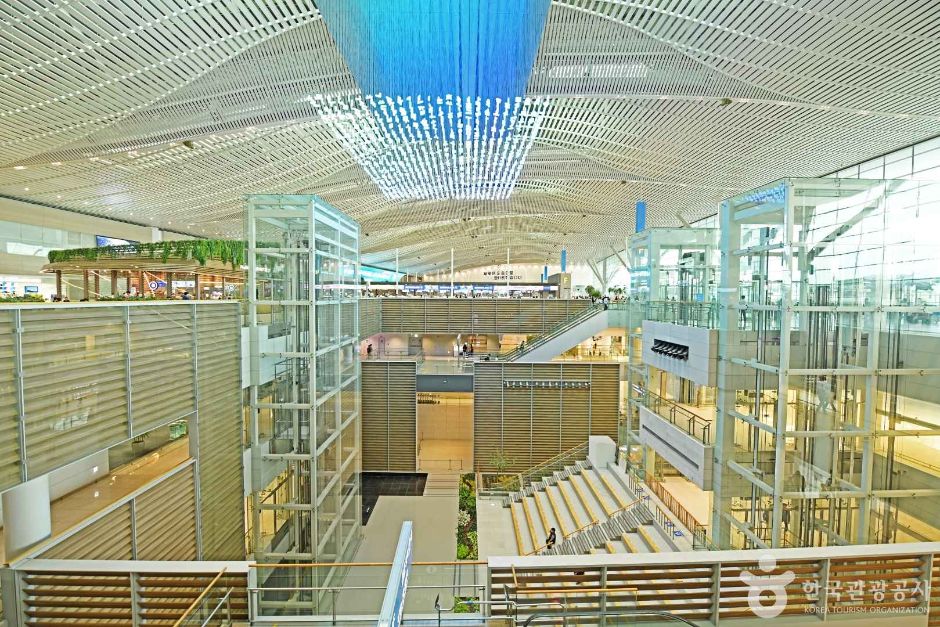
You land at Incheon, follow the signs down to the transport centre, and within about ninety seconds you have to choose something. The signs are good. What they do not tell you is that the cheapest option and the most expensive scheduled one differ by roughly three and a half times for the same journey, and that the gap gets wider after 23:00.
Everything below comes from the operators’ own pages — AREX for the trains, Incheon International Airport Corporation for the buses and taxis — and was checked on 14 August 2026. Fares change; the date matters, which is why it is here rather than buried at the bottom.
The short version
Adult, one way, Incheon Airport Terminal 1 to central Seoul.
| Cost | Journey time | |
|---|---|---|
| All-stop train (일반열차) | ₩4,750 to Seoul Station | 59 min |
| Express train (직통열차) | ₩13,000 | 43 min |
| Limousine bus | ₩17,000–18,000 | varies by route |
| Taxi | meter from ₩4,800, plus 20–40% at night | varies |
From Terminal 2 every train figure rises: ₩5,350 all-stop, and 51 minutes on the express.
If you want the answer without the reasoning: take the all-stop train. Then read the rest, because there are three situations where that is the wrong answer.
The all-stop train, and why it is the default
The 일반열차 is an ordinary commuter train that happens to end at the airport. No reservation, no assigned seat, tap in with a transit card like any subway ride.
It is also, by a wide margin, the cheapest way into the city. AREX publishes a full station-to-station fare table; here are the stations most visitors actually want.
| To / from the airport | Terminal 1 | Terminal 2 |
|---|---|---|
| Seoul Station | ₩4,750 | ₩5,350 |
| Gongdeok | ₩4,650 | ₩5,250 |
| Hongik Univ. (Hongdae) | ₩4,650 | ₩5,250 |
| Digital Media City | ₩4,550 | ₩5,150 |
| Gimpo Airport | ₩4,350 | ₩4,950 |
Adult fares on a prepaid or postpaid transit card. Journey time Seoul Station to Terminal 1 is 59 minutes, to Terminal 2 66 minutes, and AREX notes some services take 2–6 minutes longer.
Note what that table says about Hongdae: it is ₩100 cheaper than Seoul Station and one stop closer to the airport. If your accommodation is in Hongdae or Mapo, you do not need to ride to Seoul Station and double back.
The discounts, including one that surprises people
AREX’s published fare structure includes:
- Children aged 6–12 — ₩550 base, and half the adult add-on
- Teenagers aged 13–18 — ₩900 base, 20% off the add-on
- Under 6 — free, up to three infants per accompanying adult
- Aged 65 and over, registered disabled visitors, and holders of national-merit status — free, on presentation of the relevant ID or using a concession transit card
That last line is AREX’s own wording. We have not verified how a foreign passport is treated at the gate, and you should not build a budget on it — but if you are travelling with someone over 65 it is worth asking at the station office rather than assuming.
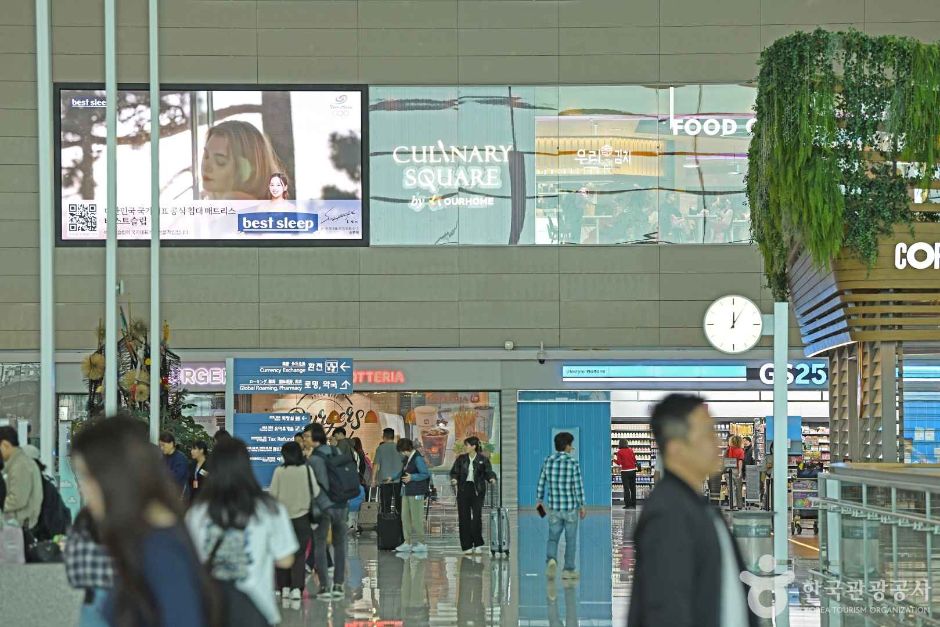
The express train: paying ₩8,250 for 16 minutes
The 직통열차 runs non-stop between the airport and Seoul Station: 43 minutes from Terminal 1, 51 minutes from Terminal 2.
AREX lists the adult fare as ₩13,000, and shows a standard fare of ₩18,500 (T1) and ₩19,100 (T2) alongside it — the ₩13,000 has been the selling price for long enough to be, in practice, the price. Children, over-65s, registered disabled passengers and national-merit holders pay ₩9,500.
So against the all-stop train you are paying about ₩8,250 extra to save 16 minutes. That is a poor rate on its own. What you actually buy is different from speed:
- A reserved seat — which matters if you are arriving at 18:00 with two suitcases into a commuter-hour all-stop train
- Free use of the Seoul Station City Airport Terminal, where you can check bags and clear immigration formalities before you travel out
- Cabin crew, an accessible toilet in car 4, free Wi‑Fi, a luggage cart service at Terminal 1
Buy the express if you have heavy luggage and no patience, or if you are leaving Korea and want to use the city terminal. Otherwise the extra buys you very little.
Limousine buses: more expensive, but they go where you are going
The airport bus network is the reason people pay four times the train fare, and it is a legitimate reason: the bus stops near your hotel, and you never carry a bag up a staircase.
Fares are set per route. A representative sample, checked on the airport’s own route search:
| Route | Toward | Fare | First bus (T1 / T2) | Last bus (T1 / T2) |
|---|---|---|---|---|
| 6001 | Dongdaemun | ₩17,000 | 05:29 / 05:39 | 23:09 / 22:49 |
| 6002 | Cheongnyangni Stn | ₩17,000 | 05:34 / 05:14 | 23:29 / 23:09 |
| 6015 | Myeongdong Stn | ₩17,000 | 05:39 / 05:19 | 23:19 / 22:59 |
| 6701 | City Hall / Gwanghwamun | ₩18,000 | 05:35 / 05:15 | 22:25 / 22:05 |
| 6703 | Gangnam / COEX | ₩18,000 | 06:15 / 05:55 | 22:55 / 22:35 |
Two things worth noticing, because both catch people out.
Terminal 2 is not the same timetable as Terminal 1. On most of these routes the T2 departure is 20 minutes earlier at both ends of the day — the bus calls at T2 first. The 6701 to City Hall makes its last T2 departure at 22:05, which is earlier than many people expect.
The last bus is earlier than the last train. If your flight is delayed, the bus is the option you lose first.
If you land after midnight
This is the part most English-language guides skip, and it is the one that matters most, because a bad answer here means sitting in a terminal until 05:00.
There are N-prefixed night routes that run when the daytime services have stopped.
| Route | Toward | Fare | First (T1 / T2) |
|---|---|---|---|
| N6701 | Dongdaemun | ₩18,000 | 00:40 / 00:20 |
| N6703 | Gangnam | ₩18,000 | 01:05 / 00:45 |
They are not a secret, but they are not signposted in English as clearly as the daytime routes, and they are the difference between reaching your accommodation and not.
Check the train timetable for your actual arrival date rather than assuming — AREX publishes it per station — but plan on the principle that after roughly midnight the choice narrows to a night bus or a taxi, and the taxi is about to get more expensive.
Taxis: the number on the meter is not the number you pay
The airport publishes a base fare of ₩4,800 for a standard taxi to Seoul, Gyeonggi or Incheon. That is where the meter starts, not what the ride costs.
What changes the total:
Night surcharges, in three bands. For Seoul- and Incheon-registered taxis:
| Time | Surcharge |
|---|---|
| 22:00–23:00 | +20% |
| 23:00–02:00 | +40% |
| 02:00–04:00 | +20% |
Gyeonggi taxis apply a flat +30% from 23:00 to 04:00. Deluxe (모범) and large 9-seat taxis start at ₩7,000 and add 20% from 22:00 to 04:00.
The out-of-area surcharge, and when it does not apply. Incheon Airport is a shared operating zone for Seoul, Incheon, Goyang, Gwangmyeong, Gimpo and Bucheon. Travelling to any of those six, there is no out-of-area surcharge. Travelling beyond them, it applies — 20% for Seoul and Gyeonggi taxis, 30% for Incheon taxis — from the point where you leave the zone.
International Taxi. The airport designates a foreign-language taxi service that uses a fixed zone fare to Seoul rather than the meter, at stands 4C (T1) and 3C (T2). For a first arrival with no Korean, a known price is worth something.
One warning the airport itself puts in bold: touts posing as taxis — call vans soliciting passengers inside the terminal — are a recurring problem. Use the marked taxi ranks. At Terminal 1 the standard taxi stands are 5C, 6C and 6D; at Terminal 2, 7C.
Choosing, in one paragraph
Take the all-stop train unless something below applies. Take the express if you have heavy bags and it is rush hour, or you are departing and want the city terminal. Take a limousine bus if it stops near your accommodation and you would otherwise change trains twice with luggage. Take a taxi if you land after the trains stop and there is no night bus toward you, if there are three or more of you splitting it, or if it is between 23:00 and 02:00 and you have decided the 40% is worth not thinking about it.
If you are staying in Hongdae, note again that the train goes there directly and slightly cheaper than to Seoul Station.
What this article does not claim
These are the operators’ published figures on 14 August 2026, taken from the pages listed at the top. Bus fares and first/last departures are set per route and change with timetable revisions; we sampled five daytime routes and two night routes, not the whole network. Check your specific route before you rely on it.
We have not ridden every option to verify journey times. The train times are AREX’s published figures. Bus and taxi durations depend entirely on traffic, which is why we have not published a single number for them — anyone who gives you one for a Seoul-bound airport bus at 18:00 on a Friday is guessing.
We have not verified how the over-65 free travel on the all-stop train is applied to foreign visitors. AREX’s published rule requires the relevant identification or a concession transit card. Ask at the station office.
Taxi totals depend on destination and traffic, and we have deliberately not estimated them. The base fare, the surcharge bands and the shared-zone rule are the published facts; the meter does the rest.
For getting around once you are in the city, what Seoul transport actually costs covers subway, bus and taxi fares inside Seoul.
Read next
Book it or find it
Trip.com · Affiliate link — we may earn a commission→AREX Express train ticket — book ahead on Klook
Klook · Affiliate link — we may earn a commission→Airport bus routes and fares — Incheon Airport official
Incheon International Airport · Suggested→Taxi stands and night surcharge — Incheon Airport official
Incheon International Airport · Suggested→
Links marked as affiliate links earn us a commission if you book through them, at no extra cost to you. The rest are official operator and government pages that pay us nothing. We were not paid to write any of this.
Sources & last checked
- Merchant official site · checked 2026-08-14 일반열차 운임안내 — 공항철도(주) AREX (역간 기준운임표, 운임체계)
- Merchant official site · checked 2026-08-14 일반열차 소개 — 공항철도(주) AREX (소요시간)
- Merchant official site · checked 2026-08-14 직통열차 소개 — 공항철도(주) AREX (운임·소요시간·할인)
- Public institution · checked 2026-08-14 택시 이용안내 — 인천국제공항공사 (기본요금·심야할증·시계할증·승차장)
- Public institution · checked 2026-08-14 버스 검색 — 인천국제공항공사 (노선별 요금·첫차·막차)