Culture & History
Bukchon Hanok Village Rules: 10am–5pm, and a ₩100,000 Fine
Bukchon is not a tourist attraction. It is a residential street, and since March 2025 visiting one lane outside 10:00–17:00 carries a ₩100,000 fine that applies to foreigners exactly as it does to Koreans. Taking a photograph is what makes you a tourist. Here is the district office's own rulebook, the exact boundaries, and where to go instead after five.
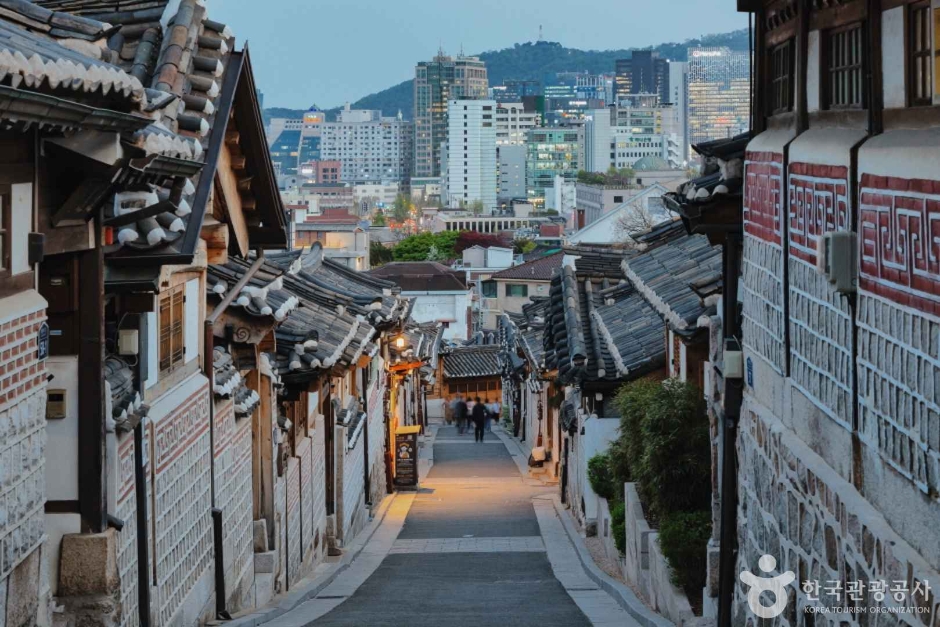
Most English-language guides still describe Bukchon as a village you wander through. That description has been out of date since November 2024, and it can now cost you money.
Since 1 March 2025, visiting the main hanok lane outside 10:00–17:00 as a tourist carries a ₩100,000 fine. Jongno District Office says explicitly that the rule applies to foreign visitors on the same terms as Koreans, and that the fine can be collected on the spot or before you leave the country.
The reason is simple and it is worth sitting with for a moment. People live there. Not caretakers of a preserved site — households, in houses whose windows are an arm’s length from the lane, on a street that had become a queue.
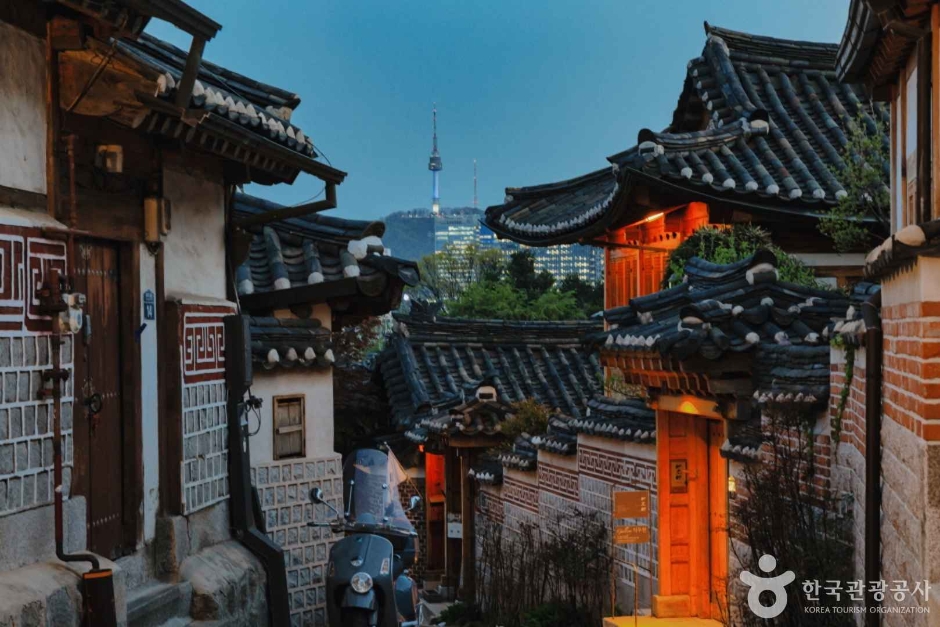
The rule, exactly
| Where | Bukchon-ro 11-gil and its immediate surroundings — about 34,000 m², designated the “Red Zone” |
| When you may visit | 10:00 – 17:00 |
| When you may not | 17:00 until 10:00 the next morning |
| Fine | ₩100,000 (reducible by up to half under the district ordinance) |
| In force since | 1 March 2025 (guidance-only period ran 1 Nov 2024 – 28 Feb 2025) |
| Applies to foreigners | Yes, under the Act on the Regulation of Violations of Public Order |
Bukchon was formally designated a Special Management Area (특별관리지역) on 1 July 2024 under the Tourism Promotion Act — a legal category for places where residents’ right to live undisturbed needs protecting.
There is also a Yellow Zone, around Bukchon-ro 12-gil. No fine there, but it is monitored and the same 10:00–17:00 window is requested. Treat it as the same rule without the penalty.
What counts as being a tourist
This is the part that surprises people, and it is the part worth reading twice.
The restriction applies to tourist activity (관광행위), not to being present. Jongno District defines it as:
- taking photographs or video
- stopping to look around, lingering
- wandering the street for reasons unconnected to using a shop
Residents, their families and guests, shop customers, shopkeepers and people simply walking through are exempt — but the district states plainly that even an exempt person becomes liable if they do any of the above.
So the practical test is not who you are. It is whether you lift your phone. Walking through Bukchon at 19:00 on your way somewhere is fine. Stopping to photograph a rooftop at 19:00 is a ₩100,000 offence.
Enforcement is done in person by staff the district calls 북촌보안관 — Bukchon marshals. They warn first and fine only if the warning is ignored. If you are staying in the zone, a booking confirmation gets you in; if you are visiting a shop, saying so or showing a receipt does. Long-stay guests are explicitly not counted as residents.
Tour buses are banned, and that changed this year
If you have booked a coach tour that promises to drop you at Bukchon, check what it actually does now.
Since 1 January 2026, charter buses are banned from about 2.3 km of streets around Bukchon — Bukchon-ro, Bukchon-ro 5-gil, Bukchon-ro 4-gil and Changdeokgung 1-gil among them. The ban runs at all times, including weekends and public holidays, and applies to any chartered coach with 16 or more seats.
Fines are ₩300,000 for a first offence, ₩400,000 for a second, ₩500,000 for a third, enforced by camera. A trial period ran from July to December 2025; the penalties are live now.
Three official drop-off points were built within 1 km, and a legitimate tour will use one of them:
- Samcheong-ro, in front of the National Museum of Modern and Contemporary Art
- Samil-daero, on the west side of Tapgol Park
- Donhwamun-ro, opposite Changdeokgung
Coaches may stop at these for five minutes and no longer. Parking is at Gyeongbokgung (48 coach spaces) or Tapgol Park, both 10–30 minutes’ walk away.
The practical consequence for you: any Bukchon visit now includes a walk. If a tour operator implies otherwise, they are either dropping you illegally or dropping you somewhere that is not Bukchon.
How to visit well
Go in the morning. 10:00 is when the zone opens and it is also when the light is on the roofs and the lanes are emptiest. The single best hour is the first one.
Do not go for sunset. The most photogenic hour is inside the restricted window. This is not an accident — evening was the worst of it for residents, which is exactly why the rule exists.
Keep your voice down and do not stop in doorways. The district calls the goal 정숙관광, “quiet tourism.” Bukchon’s lanes carry sound like a stairwell.
Do not photograph into windows or courtyards, and do not push on a gate to see whether it opens. Almost every gate you will pass is a front door.
Use the toilets before you arrive. There is no visitor infrastructure, because it is not a visitor destination.
Where to go after 17:00
The honest answer to “but I only have the evening” is: go somewhere else, and Seoul has good answers.
Ikseon-dong (익선동) — a hanok quarter about fifteen minutes away that converted to cafés, bars and restaurants rather than staying residential. It is designed to be visited in the evening, the alleys are as narrow and as photogenic, and nobody is trying to sleep behind the wall.
Gyeongbokgung and Gwanghwamun after dark — the palace grounds close, but the gate, the wall and the plaza are lit and open, and the walk along the palace wall to Samcheong-dong is one of the better night walks in the city.
Changdeokgung’s wall on Donhwamun-ro, and the Samcheong-ro strip of galleries and cafés, both sit just outside the restricted zone.
Namsan — if what you wanted was a view of Seoul with old and new in the same frame, the hill does it better and has no closing time on the path.
Why this matters beyond Bukchon
Korea is beginning to treat over-tourism as something to regulate rather than to celebrate, and Bukchon is the first place where that produced a fine aimed at individuals.
It is worth understanding the reasoning, because it explains the tone you will meet. The district was asked why it does not simply charge admission instead. Its published answer is that an entrance fee would confirm Bukchon as a tourist site, and it is not one — it is a residential neighbourhood, and the policy exists to keep it that way.
Read in that light, the rule is not hostility toward visitors. It is a boundary. Visitors who respect it are welcome inside it, which is a better deal than the alternative most over-visited neighbourhoods eventually reach.
Related
- Which of Seoul’s five palaces to choose — Gyeongbokgung and Changdeokgung both border Bukchon
- Free palace admission: who qualifies
- When to come to Korea at all — the month-by-month calendar
What this article does not claim
Rules change, and this one has changed twice already. Everything above is from Jongno District Office’s published guidance as we read it on 15 August 2026. The visiting-hour restriction took effect 1 March 2025 and the charter-bus penalties on 1 January 2026. Check the district page before you travel — it is linked in the sources, and it publishes multilingual PDFs including an English one.
We have not walked the boundary. The Red Zone is defined as “Bukchon-ro 11-gil and surroundings, approximately 34,000 m²”, mapped on Seoul’s Smart Map service. We have reproduced the district’s description rather than surveyed where the line falls on the ground. If you are near the edge in the evening, assume you are inside it.
We have not seen the enforcement in operation, and we cannot tell you how strictly the marshals apply the warning-first policy in practice.
The fine may be reduced. The district ordinance permits a reduction of up to half. We do not know on what basis that discretion is exercised.
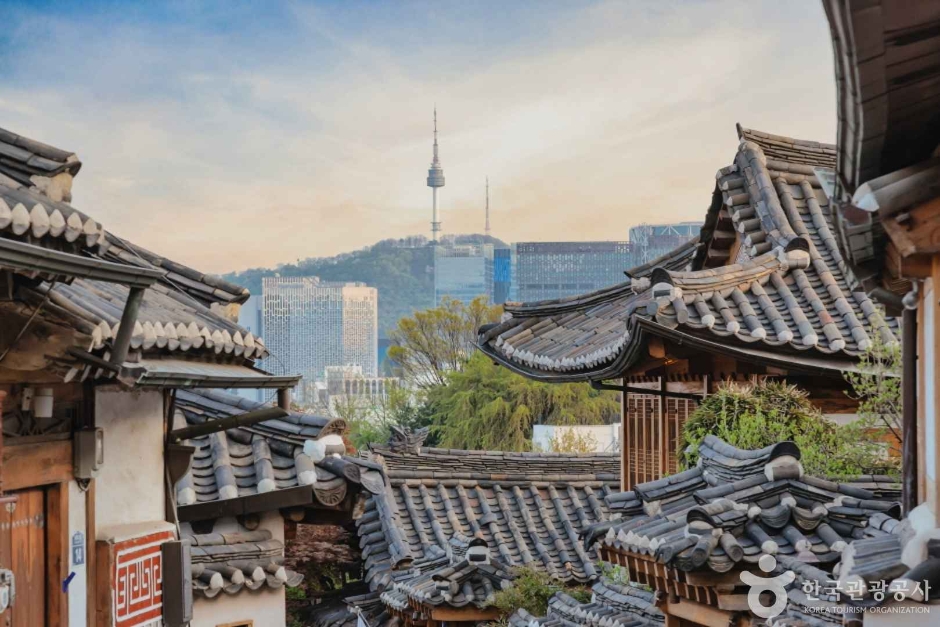
The photographs on this page were taken before the restriction existed, are published by the Korea Tourism Organization under an open licence, and are used here with permission of that licence. They are not evidence that photography is currently permitted where they were taken.
Sources: Jongno District Office — Bukchon Special Management Area
Read next
Sources & last checked
- Public institution · checked 2026-08-15 북촌 특별관리지역 안내 — 종로구 (관광객 방문시간 제한·전세버스 통행제한·Q&A 33항)
- Media · checked 2026-08-15 북촌 한옥마을 '레드존' 관광 시간… 3월부터 위반 땐 과태료 10만원 — 경향신문