HANKUKIN Scenes · Itaewon Class
Itaewon: Seoul's One Neighbourhood Where Turning Up Alone Is Normal
Seoul is a city built for groups — tables of two, bookings that ask how many. Itaewon is the exception, and there is a reason for it: the neighbourhood grew around an army base and forty-odd embassies, full of people passing through. Here is what to eat on the hill, what the antique street actually sells, and the honest answer to when it feels like a festival.
Why this scene matters
Korea is hard to be alone in, and the rules say so out loud.
We spent a day reading what two broadcasters require of anyone who wants to sit in a music show audience. KBS books Music Bank two seats at a time, with the companion’s name entered at the application and both people required at the door. A solo traveller who wins that lottery has not won a seat. Restaurants portion for two. Booking forms open with how many.
Itaewon is the exception. Not because the people are friendlier — that is not a thing we can measure — but because of what the neighbourhood is made of.
The night I gave up and he did not
In 2011 I took a friend to Itaewon. He wanted to keep going; I did not. I left him there and went back to the hotel alone, which is a polite way of saying I abandoned him on a street corner near midnight.
He reappeared three days later. He had made a great many friends, he said, Korean and foreign, and he seemed faintly puzzled that I had left.
I am telling you this with the date attached because 2011 was fifteen years ago and this article is not a promise. The army has largely gone. There has been a disaster. The rents have changed. What has not changed is the thing that made three days possible, and that is worth explaining before anything else.
Why this one neighbourhood is different
Itaewon sits beside what was, for decades, the United States Army garrison at Yongsan, and among a cluster of embassies. Both facts produced the same kind of resident: people who were here for a while and then would not be.
A neighbourhood built for people passing through develops habits. Someone arriving alone is not an event. Nobody is waiting for the rest of your party.
One correction, because it gets repeated carelessly and we nearly did it too. The base did not simply leave. The Eighth Army headquarters moved to Pyeongtaek in 2017, and much of the land has been returned in stages — but parts of the Yongsan site remain in American use, including a hotel, a helipad and an access area, classified as retained land rather than returned. The honest verb is not left. It is shrank.
The drama, briefly, and then we will stop
Itaewon Class (2020) is why a lot of people know the name. Netflix’s own logline is short:
이태원 클라쓰 — 넷플릭스 공식 소개 In a colorful Seoul neighborhood, an ex-con and his friends fight a mighty foe to make their ambitious dreams for their street bar a reality.
Netflix, official title page for Itaewon Class Netflix, 「이태원 클라쓰」 공식 작품 페이지 20 August 2026
What is worth noticing is how Netflix files it. Not simply as a romance or a revenge drama: the genre list includes Social Issue TV Dramas, and the synopsis Netflix wrote for episode eight is four words long — “Kim Toni deals with discrimination.” Toni is the son of a Korean father and a Guinean mother, and he is turned away from a club for looking foreign while speaking Korean.
So the show is not really about a bar. It is about who counts as belonging here — which is the same question the neighbourhood has been answering, imperfectly, for fifty years.
We are not going to summarise the plot. You have either seen it or you have not, and both are fine.
What to eat: walk uphill
Come out of Itaewon Station exit 3 and walk straight, and you reach the bottom of Usadan-ro. Go up.
This is the halal quarter, and Yongsan District has treated it as one — it ran a project to develop Usadan-ro and Usadan-ro 10-gil as a halal food street, and in 2017 surveyed the restaurants and printed a map of them in Korean-English and English-Arabic editions. Roughly fifty halal restaurants and grocers sit in this small area.
At the top of the hill is the reason all of it is there.
The Seoul Central Mosque opened on 21 May 1976, the first mosque in Korea, on land the government granted in 1969 and with construction funded by Saudi Arabia and other Muslim countries. Its own page describes what surrounds it plainly: halal restaurants, a halal butcher, an Islamic bookshop, a halal supermarket, a travel agency.
For a visitor this is the practical shape of it: the restaurants and the mosque are the same walk. Eat on the way up or the way down.
If you are working out whether you can eat anything in the rest of the country, we have a separate article on how Korean food handles halal and vegetarian requirements, and the short answer is that it is harder than it looks.
The mosque: four things nobody tells you
All of this is from the mosque’s own visiting page, read on 20 August 2026.
You do not need to apply. The application form is for group visits, filming, interviews and lectures. Its own wording is explicit:
따로 개인적 관람으로 직원의 도움이 필요하지 않거나 짧은 안내만 필요하실 경우는 방문 신청 없이 바로 방문 가능하십니다. If you are visiting privately and do not need staff assistance, or only need brief directions, you may simply visit without an application.
Korea Muslim Federation, mosque visiting information and application 한국이슬람교중앙회, 「성원 방문안내 및 신청」 20 August 2026
They will lend you clothes. If you arrive dressed too briefly, the page says there is a changing room beside the guard post stocked with skirts and headscarves, and that you put them on and then look around. You are not sent away.
You cannot go inside the prayer hall. It is the first line on the list of things strictly restricted, along with pets, photographing during prayers, photographing anyone without their agreement, smoking, drinking and shouting.
Hours are 10:30 to 17:00, and the page names the times to avoid: the half hour either side of each prayer, and Friday between 12:00 and 15:00, when it is too busy for anyone to show you around.
What to buy: the street the army left behind
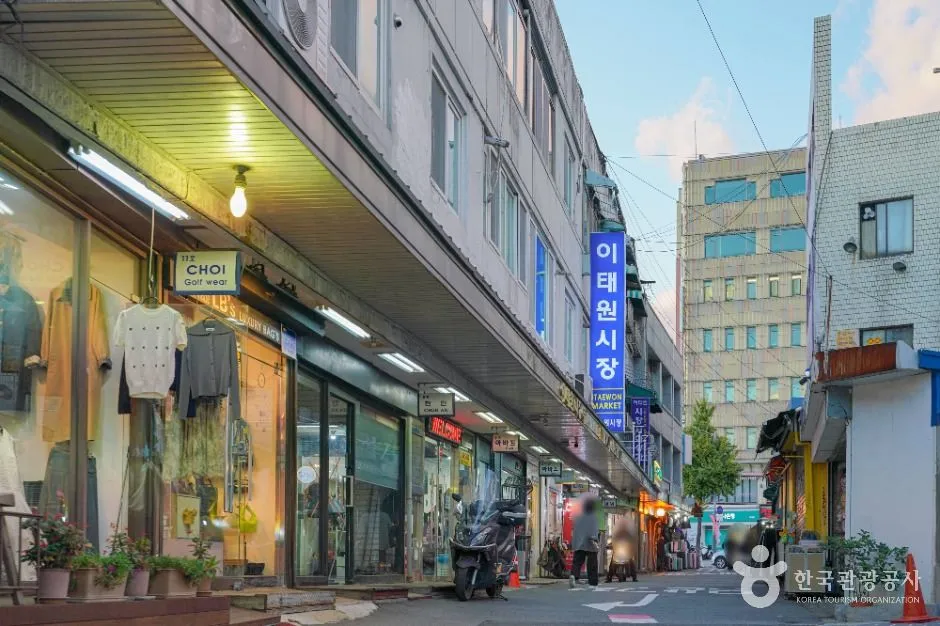
Walk out of the station on the other side, past the Hamilton Hotel towards Bogwang-ro, and you are on the antique furniture street.
Its origin is the whole argument of this article compressed into one fact. In the 1960s American soldiers rotating home sold the furniture they had been living with. Dealers grew up around that trade, then began importing, and now the run of shops carries European, American and Asian pieces — furniture, but also clocks, teacups and small ornaments. The stretch runs roughly from Itaewon Station past the Cheonghwa Apartments towards the Saudi Arabian embassy.
We are not going to give you a shop count. The association’s own website would not load for us on 20 August 2026, at either address we tried, so any number we printed would be borrowed from somewhere we had not checked.
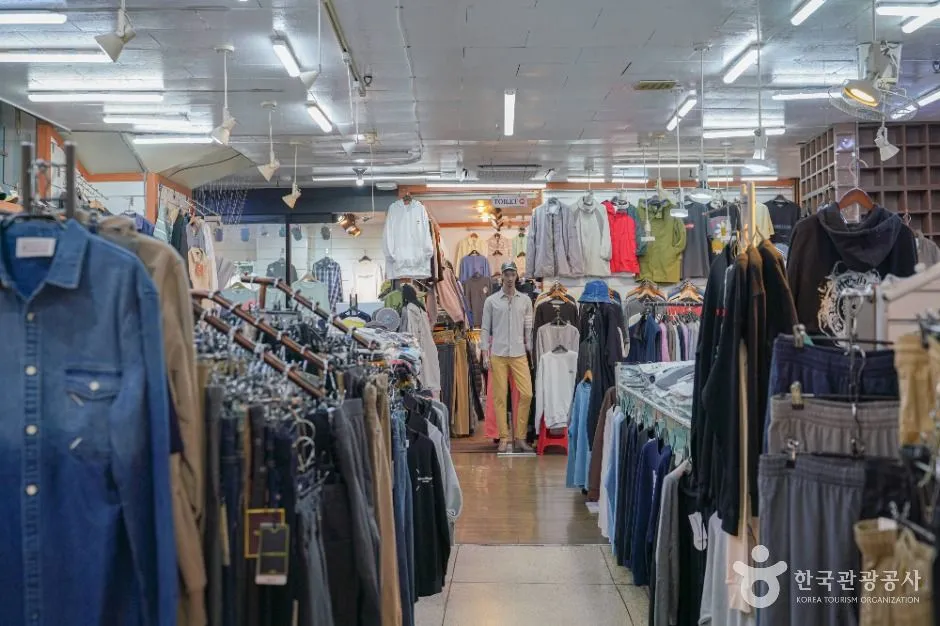
The other shopping is more ordinary and easier: the covered clothing market near the station, small stalls of shirts, coats and bags. It is not glamorous. It is cheap, it is indoors, and it is open when the weather is not.
When it feels like a festival — the honest answer
Two festivals. One of them has stopped.
The Itaewon Global Village Festival ran every October from 2002. Seoul’s own culture portal describes it as the Korean festival with the largest embassy participation — around forty countries sending parade teams, performers and crafts — with a global street parade, a world culture awards event, and, in the portal’s own words, a late-night DJ party as the highlight. More than a million visitors a year.
The same page lists its dates as 15–16 October 2022.
That was the last edition. The Itaewon crowd crush happened two weeks later, on 29 October 2022, and 159 people died in an alley off the main street. The festival has not run since. In September 2025 the district office hosted a public discussion on whether and how to restart it. As of this writing there is no announced date.
So do not travel in early October expecting that festival. Check before you plan around it.
What is running is the antique and vintage festival on the furniture street, held twice a year in spring and autumn — flea market stalls, antique auctions, buskers, caricaturists, wine tasting. A spring 2026 edition took place. We could not open the organisers’ site to confirm exact dates, so we are telling you the season and not the day.
And Halloween: the crowds came back in 2025, under heavy management. Police ran a special operation across the Halloween period with roughly 4,900 officers citywide; several hundred were deployed in Itaewon itself, directing one-way pedestrian flow with barriers. The alley where the crush happened was closed to entry.
The practical part, kept short
Assume the station may stop stopping. Seoul Metro’s guidance for the Halloween period is that Itaewon, Hongdae and Seongsu stations may be run through without stopping depending on conditions — it is not a published timetable, it is a decision taken when the platforms fill. On 31 October 2025 that decision came at about 11pm, announced by emergency text.
The practical consequence is not a time to memorise. It is this: on a crowded night, plan your way out on the assumption that the station is not available. Walk to the next station, or arrange a pickup point away from the main street, before you need it.
Most nights of the year, none of this applies and the station is a station.
Going alone
Here is what we can and cannot tell you.
We cannot tell you that you will make friends. That is not a fact and we have no way to check it. What we can tell you is the structure: this is a neighbourhood of people who arrived from somewhere else and knew they were temporary, where a mosque lends clothes to strangers who turn up underdressed, where the shops were built out of what departing soldiers left behind. Arriving alone is the normal case here, not the exception.
In Korea, turning twenty and going to Itaewon is close to a rite of passage — the first place many young Koreans go once they are legally adults. You will be walking the same streets on the same night, for entirely different reasons.
My friend stayed three days. I went back to the hotel. Fifteen years later I am still the one who has to explain himself.
Related
- Music Bank wants two names — the rules that stop solo travellers
- Is Korean food halal or vegetarian? The hidden pork and fish
- Seoul transport fares 2026: subway, bus and taxi costs
What we could not check, and did not write
The antique street’s own website. We tried two addresses on 20 August 2026 and neither loaded. So there is no shop count and no festival date in this article — only the season and the stretch of road, which several independent descriptions agree on.
Whether the Global Village Festival returns in 2026. We found the 2025 discussion but no announcement. We are not guessing.
Anything about how the evening goes. We have not sat in these bars and counted whether they have counter seats, or whether they serve one portion. When we can check that properly we will write it; until then the paragraph above says only what the neighbourhood is made of, not what will happen to you in it.
The filming locations. Itaewon Class is set in Itaewon, which is where you should go. Where individual interiors were shot is a production detail that would not improve anyone’s evening, so we have left it out.
Read next
Sources & last checked
- Official — production · checked 2026-08-20 Itaewon Class — Netflix official title page (logline, cast, genre tags, episode synopses)
- Merchant official site · checked 2026-08-20 성원 방문안내 및 신청 — 한국이슬람교중앙회 (visiting hours, dress, what is restricted, when to avoid)
- Merchant official site · checked 2026-08-20 서울중앙성원 — 한국이슬람교중앙회 (history, address, and the shops around it)
- Public institution · checked 2026-08-20 이태원지구촌축제 — 서울문화포털, 서울특별시 (the festival page, still showing October 2022)