HANKUKIN Scenes · Lovely Runner (선재 업고 튀어)
Lovely Runner Filming Locations in Suwon: The Wall Is Free, the Palace Is Not
The Lovely Runner scenes were shot around Haenggung-dong in Suwon, next to a fortress wall that costs nothing and never closes — and a palace that costs ₩2,000 and shuts at six. The two are named one letter apart, and the confusion starts before you leave the station.
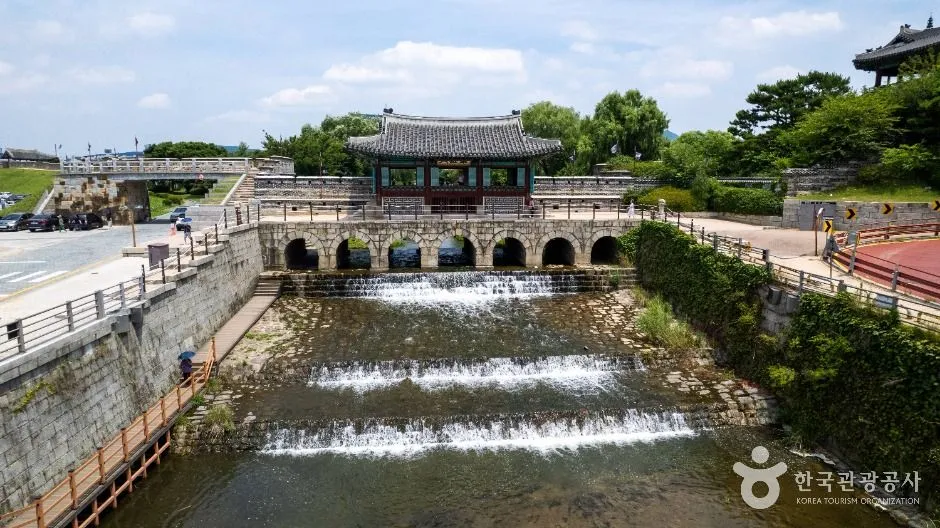
Why this scene matters
Two thousand won. That is the entire admission charge at the centre of this article, and almost everyone who arrives in Suwon for Lovely Runner pays it in the wrong place, at the wrong time, or does not need to pay it at all.
The problem is the names. 수원화성 (Su-won Hwa-seong) is the fortress — five and a half kilometres of wall with four gates, wrapped around the old town. 화성행궁 (Hwa-seong Haeng-gung) is the palace inside it. In English both get flattened to “Hwaseong,” and the ticket rules for the two are not similar at all.
One of these charges you and one of them does not
The wall is not a ticketed attraction. It has no gate, no counter and no closing time, and the operator says so in one line:
수원화성은 개방형이며 야간 관람 가능 Suwon Hwaseong is open-plan, and night viewing is possible.
Suwon Cultural Foundation, Suwon Hwaseong visitor information 수원문화재단 — 수원화성관광 이용안내 17 August 2026
You can walk onto the rampart at two in the morning and nobody will stop you. The fee table on the same page — the one that says ₩2,000 — applies to the palace and to Hwaryeongjeon, the shrine beside it. Nothing else.
| Hours | Adult | Youth / military | Child | |
|---|---|---|---|---|
| Suwon Hwaseong (the wall) | Always open, year-round | Free | Free | Free |
| Hwaseong Haenggung (the palace) | 09:00–18:00, year-round | ₩2,000 | ₩1,500 | ₩1,000 |
| Combined ticket — palace + two museums | Museum hours vary | ₩4,000 | ₩2,500 | ₩1,000 |
| Hwaseong trolley (화성어차, Hwa-seong-eo-cha) | From Yeonmudae | ₩6,000 | ₩3,500 | ₩2,000 |
Checked against the operator’s page on 2026-08-17.
Three things in that table cost people a day. Last entry at the palace is 17:00, a full hour before the stated closing time. The trolley leaves from Yeonmudae, on the far east side of the circuit, not from the palace where most visitors start. And the combined ticket only pays for itself if you actually want two museums — at ₩4,000 it is double the palace alone.
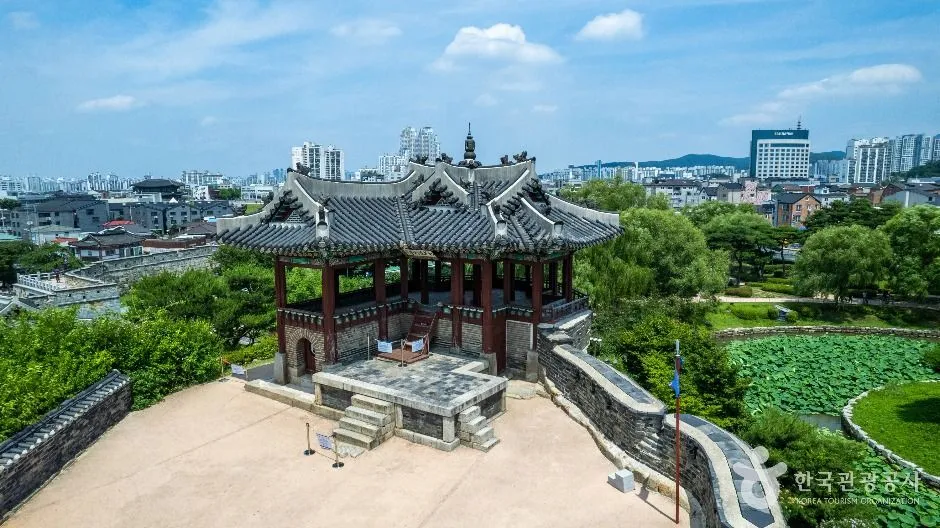
Where the drama actually was
Lovely Runner was filmed around 행궁동 (Haeng-gung-dong), the neighbourhood inside the walls, and specifically along the lanes near 화홍문 (Hwa-hong-mun) — the water gate at the top of this page, where the wall crosses the Suwoncheon stream. Kyunghyang Shinmun, reporting from the area, places the romance scenes on that stretch: the water gate, the stepping stones across the stream, and 방화수류정 (Bang-hwa-su-ryu-jeong), the pavilion just above it.
The same report identifies the two spots people actually queue for. Hwahong Mart, a corner shop on the culture street, gave the crew the run of the store and now has stills from the episodes pinned up outside. And the house where Im Sol lived at nineteen is now a café.
We are grading this as reported rather than official. The production filmed openly enough that local traders described it to a reporter on the record, and the operator’s tourism site keeps a section called TV속 수원화성 — “Suwon Hwaseong on TV” — though it points off to a blog rather than to a filming register we could check. What we did not find is a statement from the production company naming these addresses. So we are not going to write one.
Someone lives behind the blue gate
The house used for Ryu Sun-jae, opposite the café, is a private home with residents in it. The newspaper that reported the location said so in the same breath as reporting it, which is unusual and worth repeating: this is a lane where people take their bins out.
Photograph the gate from the street, keep your voice down, and do not go up to it. Fans arrive here with yellow umbrellas — that part is a genuine local custom now, and it is fine. Knocking is not.
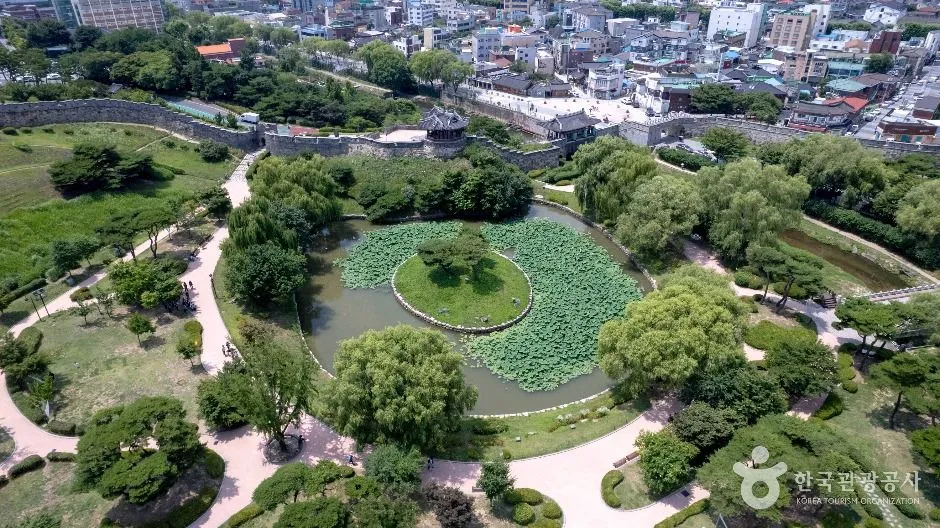
The exemptions, and the one we could not pin down
You do not have to pay the ₩2,000 at all if you turn up in 한복 (han-bok). The operator’s wording is broad:
한복(개량한복 포함) 착용 시 When wearing hanbok (including modernised hanbok).
Suwon Cultural Foundation, Hwaseong Haenggung admission notes 수원문화재단 — 화성행궁 관람 안내사항 17 August 2026
That is the same mechanism the Seoul palaces use, and the same arguments about what counts apply — we have written up what gets accepted and what gets refused in detail.
Beyond hanbok, admission is free for visitors aged 65 and over with ID and for children under six. Entry is also free on Culture Day, the last Wednesday of each month — but explicitly not during the night opening, which is the one time most travellers would want it.
Here is where the sources stop agreeing. The foundation publishes the same exemption table on two of its own sites. On the Suwon Hwaseong tourism site, the block listing the age, voting, disability and multi-child exemptions carries the note “내국인만 적용” — Korean nationals only. On the foundation’s own site the equivalent note is narrower, marking only the multi-child clause as limited to Suwon residents. Same operator, same table, two different scopes.
We are not going to guess which is current. The practical reading: hanbok, 65-and-over with ID, and under-six are the three a foreign visitor can reasonably expect to be honoured, and even those get decided at the ticket window. Bring the ID. Budget the ₩2,000 anyway.
Night, and what it costs
From 1 May to 1 November 2026 the palace opens again in the evening, Friday to Sunday and on public holidays, 18:00–21:30 with last entry at 21:00. The foundation notes the dates can move at its discretion. Today falls inside that window, but it closes for the winter and the daytime hours are all you get from November.
The wall, of course, does not close at all. If the night opening is finished for the year or you have missed the last entry, the stream and the water gate are lit and free, and that is the stretch the drama used anyway.
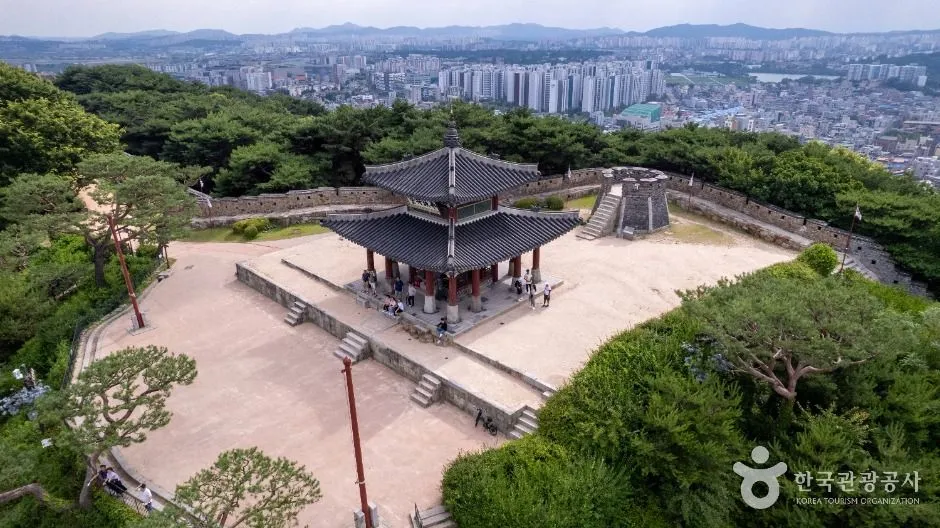
Getting there, and the name that sends people to the wrong city
Suwon Station sits on Seoul Subway Line 1 and takes about an hour from Seoul Station with no change. Using the city’s published fare rule — a ₩1,550 base fare with a card, plus ₩100 for every 5 km past the first 10 km — the ride works out at roughly ₩2,200–2,400. That is a figure we calculated from the rule rather than one quoted on a fare table, so treat it as an estimate; the full fare structure is here.
The fortress is not at the station. It is about 2 km north, and the walk is along an ordinary arterial road. Take a bus or a taxi for that leg.
One more trap, and it is the worst one. 화성시 (Hwa-seong-si) is Hwaseong City — a separate municipality roughly 30 km away, with its own government and its own cultural foundation. English maps and booking sites render it “Hwaseong,” identically to the fortress. If you are searching in English, search “Suwon Hwaseong” with Suwon attached, every time. Accommodation booked in Hwaseong City is not near the wall and there is no easy transfer.
If you would rather ask a person: the Suwon General Tourist Information Centre is near Exit 4 of Suwon Station, open 09:00–18:00, with English, Chinese and Japanese interpretation available.
What this article does not claim
Fees, hours and the night-opening dates are as published by the Suwon Cultural Foundation on 2026-08-17 and were read from the operator’s own pages, not from aggregators. Korean admission fees change by municipal ordinance, and this one was last raised in February 2025 — check before you budget precisely.
The filming locations are reported by Kyunghyang Shinmun from the neighbourhood, not confirmed by the production. We have not walked these lanes ourselves. We are not naming the café or the blue-gate house by address, and we would ask you not to either — one of them is a home.
The Seoul–Suwon fare is calculated from the published distance formula, not quoted. Exact ticketed fares differ by card type and entry station.
Photographs on this page are Korea Tourism Organization aerial images of Suwon Hwaseong. They show the fortress, not the drama’s shooting locations, and we have captioned them for what they are. We requested images of Hwaseong Haenggung as well; what arrived was a hotel of a similar name, and those four frames were discarded rather than published.
How to get a similar photo
- Where to stand
- Downstream of the water gate, on the railed walkway that runs along either bank. From the bank you get the whole row of arches in one frame; from the channel itself you are too close and too low.
- Which way to face
- Face upstream, toward the gate. The pavilion on top of it is the part that reads on camera.
- Framing
- horizontal · 1x. The gate is wide, not tall — a crop loses the arches, which are the whole point of the frame.
- Best time
- After dark. This stretch is lit at night and that is what it is known for locally. In daylight go early — the stone faces east and midday flattens it.
- Avoiding crowds
- Weekday mornings are quiet. Weekend evenings are not, and the drama has added to that.
- Simple props
- a yellow umbrella, which is what fans carry here, a light layer — the stream bank is cooler than the street
This is a suggested photo angle for visitors, not the production's confirmed camera position.
The place
- Name
- Hwahongmun, Suwon Hwaseong · 화홍문 (수원화성)
- Address
- Buksu-dong 33-4, Paldal-gu, Suwon-si, Gyeonggi-do, South Korea
- Status
- Operating
- Best season
- Spring and autumn. Suwon's summer is hot and wet, and the stream stretch has almost no shade.
- Getting there
- Suwon Station is on Seoul Subway Line 1, direct from Seoul Station in about an hour. From Suwon Station the fortress is a short bus or taxi ride north — the wall is not at the station, which catches people out.
- Transport
- Seoul Station to Suwon Station is roughly ₩2,200–2,400 with a transit card — the base fare plus the published distance surcharge. Checked 2026-08-17.
- Admission
- The fortress wall is free and always open. Hwaseong Haenggung palace is ₩2,000 for an adult, 09:00–18:00.
- Bring
- a transit card, shoes for a long walk on stone, ID if you are 65 or over and want the exemption
The stream is channelled below the gate and drops over a series of low weirs. Both banks have railed walkways set close to the water; the crossings out in the stream do not have rails and sit low. Suwon's summer is its wet season — after heavy rain, use the road bridge beside the gate rather than anything in the channel.
Fit it into your day
- Morning The wall, from Hwaseomun to Janganmun
The gentlest section of the circuit and the one to do first while it is cool. No ticket, no gate, no opening time. - Lunch Haenggung-dong
The lanes behind the palace. This is where the drama was shot and where most of the cafés are. - Afternoon Hwaseong Haenggung
Last entry is 17:00 — an hour before closing. Leaving the palace to the end of the day is the most common way to miss it entirely. - Evening Hwahongmun and the stream
Lit after dark. From May to early November the palace also opens at night, Friday to Sunday, on a separate ticket.
Korean culture & history nearby
Suwon Hwaseong was built in the 1790s by King Jeongjo, who moved his father's grave and then moved the town, and the fortress is the result of that grief becoming a construction project. The whole build was documented in the *Hwaseong Seongyeok Uigwe*, a record so exact that it is what made the twentieth-century restoration possible after the wall was damaged in the colonial period and the Korean War. Suwon has since become a standing set for period productions for the same reason it draws visitors — it is a walled town centre that still has a town inside it.
Read next
Sources & last checked
- Public institution · checked 2026-08-17 이용안내 — 수원화성관광 (Suwon Cultural Foundation, official visitor information: hours, fees, exemptions, trolley)
- Public institution · checked 2026-08-17 수원화성관광 > 관람안내 > 안내 — 수원문화재단 (same operator, foundation site)
- Media · checked 2026-08-17 ‘선재 업고 튀어’도 여기서 찍었다고요? 인기드라마 단골 촬영지 수원 — 경향신문