HANKUKIN Scenes · When Life Gives You Tangerines
Seongsan Ilchulbong at Sunrise: The Hours, the Fee, and the Monday the Gate Is Locked
Jeju's sunrise peak closes on the first Monday of every month, opens at 05:00 in September, and stops selling tickets an hour before it shuts. The office that runs it also publishes sunrise times measured at the peak itself — and August is missing from that table. Here is what it costs, who counts as an adult, and why you cannot do this as a day trip from Jeju City.
This article contains affiliate links, marked where they appear. If you book through one we may earn a commission at no extra cost to you — how this works.
This article contains affiliate links. We may earn a commission if you book or purchase through them, at no additional cost to you.
Why this scene matters
This article went up on Monday, 7 September 2026. Anyone who set an alarm for four that morning, paid for a taxi across the island and stood at the ticket window in the dark would have found it shut. Not because of weather. Because it was the first Monday of the month.
That is the rule, and it is the single most expensive thing to not know about Jeju’s most visited natural landmark. It is printed on the operator’s own page, in Korean, inside a tab that most English write-ups never open — which is why so many of them describe Seongsan Ilchulbong (seong-san il-chul-bong) as open every day of the year.
성산일출봉 휴관일 매달 첫 번째 월요일 Seongsan Ilchulbong, closed days: the first Monday of every month.
Jeju World Heritage Office 제주특별자치도 세계유산본부 7 September 2026
The gate opens before the sun, but not by much
The office runs three sets of hours, and it also closes the ticket window a full hour before the site itself shuts. That second number is the one that catches people arriving in the afternoon.
| Season | Open | Last tickets sold |
|---|---|---|
| May – August | 04:30 – 20:00 | 19:00 |
| March – April, September – October | 05:00 – 19:00 | 18:00 |
| January – February, November – December | 06:00 – 18:00 | 17:00 |
The same page carries one more line, in a footnote, that no English summary we have seen reproduces. It means the table above is a plan and not a promise — the sign posted at the gate outranks anything printed here, including this article.
*필요시에는 관람시간을 따로 정할 수 있음 *Opening hours may be set separately when necessary.
Jeju World Heritage Office 제주특별자치도 세계유산본부 7 September 2026
Now put those opening times against the sunrise. The same office publishes a sunrise table, and it is not a Jeju City table borrowed from the weather service — the footer says it is measured at the peak itself. That is unusual enough to be worth the trip through a Korean-only page.
※ 성산일출봉 기준 ※ Measured at Seongsan Ilchulbong.
Jeju World Heritage Office, sunrise and sunset table 제주특별자치도 세계유산본부, 일출·일몰 정보 7 September 2026
| Date (2026) | Gate opens | Sunrise | You have |
|---|---|---|---|
| 1 April | 05:00 | 06:21 | 81 min |
| 30 April | 05:00 | 05:46 | 46 min |
| 1 May | 04:30 | 05:45 | 75 min |
| 31 May | 04:30 | 05:24 | 54 min |
| earliest in June | 04:30 | 05:22 | 52 min |
| 31 July | 04:30 | 05:44 | 74 min |
| 1 September | 05:00 | 06:06 | 66 min |
| 30 September | 05:00 | 06:26 | 86 min |
The last days of April are the tightest window in the whole published year: the gate opens 46 minutes before the sun does. And here is the honest gap in this article — the operator does not publish how long the climb takes. Popular sources say anything from fifteen minutes to an hour, which is another way of saying nobody has measured it for you. So we are not printing a number. Treat the whole gap as the budget, be first through the gate, and if you are there in late April do not stop for photographs on the way up.
August is missing from the sunrise table
We opened all twelve months of 2026 on that page. This is what is actually there:
| Month (2026) | Sunrise times published |
|---|---|
| January – March | none |
| April – July | yes |
| August | none |
| September | yes |
| October – December | none |
October 2025 was empty too, so this is not a table that fills in behind you. Two things follow. The first is that a visitor planning for autumn foliage or a New Year sunrise — the two occasions Koreans actually come here for, and the site holds a sunrise festival on 31 December — cannot get a time from the office that runs the place. The second is smaller and stranger: August, the busiest travel month in Korea, is the one blank month sitting inside an otherwise continuous run.
We have no explanation for it and we are not inventing one. We are telling you it is blank so that you do not go looking for a number that is not there.
Who counts as an adult
| Ticket | Individual | Group of 10+ | Applies to |
|---|---|---|---|
| Adult | ₩5,000 | ₩4,000 | 25 to 64 |
| Youth or serving soldier | ₩2,500 | ₩2,000 | 13 to 24 |
| Child | ₩2,500 | ₩2,000 | 7 to 12 |
Parking is free. Those were the fees on the operator’s page on 7 September 2026; admission prices in Korea are revised without much warning, so if you are reading this a season later, budget loosely. Now read the right-hand column again: an adult here starts at 25, not 19 and not 18. A 24-year-old pays the youth fare, which is the opposite of what almost every English page about Korean admission prices will have trained you to expect.
The table has no row for children under 7 and no row for visitors 65 and over. Both are very probably free, and we are not going to write that they are, because the operator has not. The number on the page is 064-710-7923.
The postcard is a view of the cone, not from it
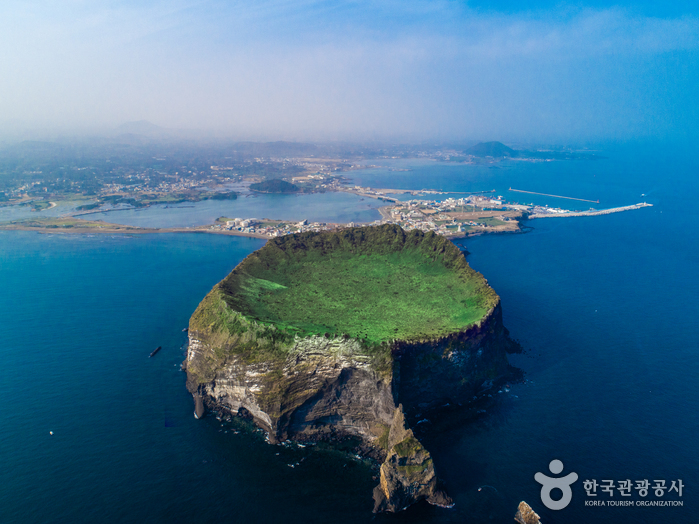
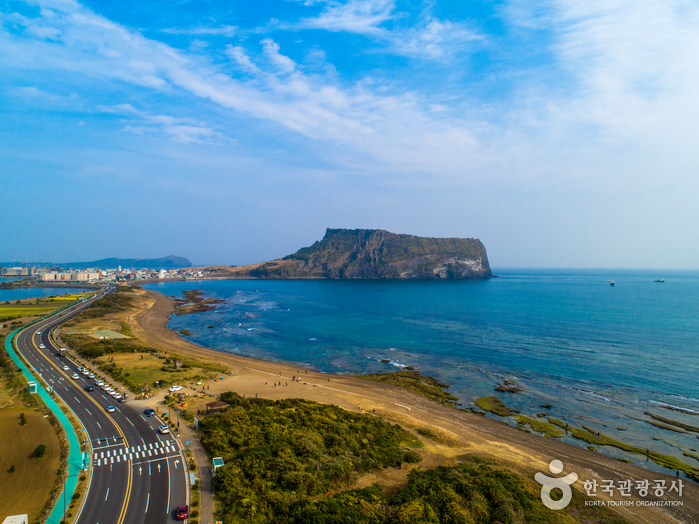
Something we noticed while checking the photographs for this article, and it changes what the ₩5,000 is for. Of the four official images of Seongsan Ilchulbong we looked at, three were taken from somewhere else — the shore, the road, a viewing frame across the bay. Only the aerial shows what you actually buy: the green bowl inside the crater.
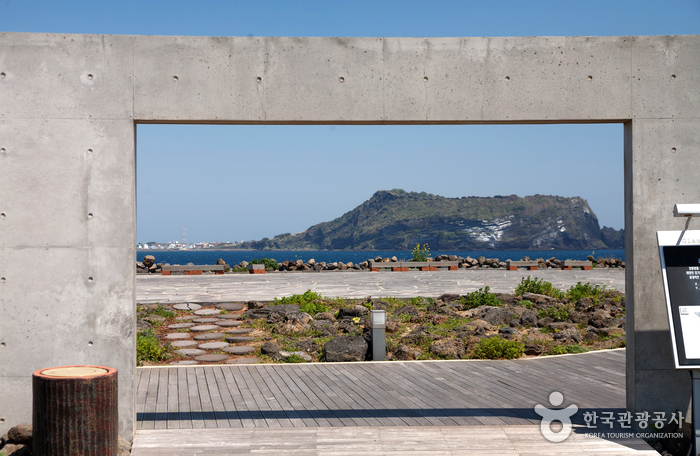
So decide which one you came for. The silhouette that appears in every Jeju photograph is a picture of Ilchulbong, taken from across the water, and you cannot take it from the summit. The ticket buys the crater, the ash layers in the cliff, and the height. If you have someone in the group who would rather not climb a sea-cliff staircase, the shore is not a consolation prize — it is where the famous view is.
이러한 지형을 육계사주(陸繫沙洲)라고 한다 This landform is called a yukgyesaju — a land-tied sand bar.
Jeju World Heritage Office 제주특별자치도 세계유산본부 7 September 2026
Why you cannot do this from Jeju City
The office publishes its own transit times: about 70 minutes from Jeju International Airport, about 68 from Jungmun, about 57 from Seogwipo, all along Route 1132, alighting at Seongsan.
Those are daytime journeys. Run the arithmetic for September and you need to leave Jeju City at about 03:45 to be at the gate at 05:00. We could not confirm that any bus runs at that hour. The Jeju bus information system gave us the stops and the routes but would not return first departures or fares, so we are not printing either. The conclusion does not depend on the missing number, though: the sunrise at Sunrise Peak belongs to people who slept in Seongsan. Book the village, not the city.
If you are not driving — and Korea does not accept every foreign licence, which we covered in our guide to the island behind When Life Gives You Tangerines — an organised day tour solves the daylight problem and not the sunrise one. It arrives when everyone else does.
One last thing, for the ride over. The village name and the peak name are standard Korean, but almost nothing else you hear on that bus will be, and Jeju’s own language is far enough from Seoul Korean that mainland Koreans need subtitles too.
Everything above — hours, closed days, fees, sunrise times, transit times — comes from two pages run by the office that operates the site, read on 7 September 2026. Where we have written that something is missing, it is missing from those pages, and we have not filled the hole from anywhere else.
How to get a similar photo
- Where to stand
- For the silhouette everyone knows, stand away from the cone — on the shore across the bay, or on the road coming down from Gwangchigi. The famous picture is a picture of Ilchulbong, and you cannot take it while standing on it.
- Which way to face
- Face east over the water. The flat top and the cliff face read as one shape from the north and south; from directly west the cone flattens out and loses it.
- Framing
- horizontal · 1x from the shore. The cone is wide, not tall — 180 m — and a crop makes it look like an ordinary hill.
- Best time
- First light, for the reason the place is named. In late April the gate opens only about 46 minutes before the sun does; in September it is about 66 to 86 minutes.
- Avoiding crowds
- The first Monday of the month is not a quiet day. It is a closed day.
- Simple props
- a wind layer — the summit path is an exposed sea cliff, a torch if you go up in the dark
This is a suggested photo angle for visitors, not the production's confirmed camera position.
The place
- Name
- Seongsan Ilchulbong (Sunrise Peak) · 성산일출봉
- Address
- 284-12 Ilchul-ro, Seongsan-eup, Seogwipo-si, Jeju-do, South Korea
- Status
- Operating
- Best season
- September. The gate opens at 05:00, sunrise runs from 06:06 to 06:26, and the staircase is not being climbed in August heat. It is also the only autumn month for which the operator publishes sunrise times at all.
- Getting there
- Public bus along Route 1132, alighting at Seongsan. The operator's own figures: about 70 minutes from Jeju International Airport, about 68 from Jungmun, about 57 from Seogwipo. Those are daytime journeys — we could not confirm any bus that reaches the gate before it opens.
- Transport
- Not published on the operator's page, and the Jeju bus information system did not return fares or first departures when we checked on 2026-09-07. We are not printing a number we could not open.
- Admission
- ₩5,000 adult, ₩2,500 youth or child, ₩4,000 and ₩2,000 for groups of ten or more. Parking free. Checked 2026-09-07 against the Jeju World Heritage Office page.
- Bring
- cash or card for the ticket window, a wind layer, shoes you can climb stairs in — the operator asks for 'trainers, light clothing'
The paid route to the crater rim is a continuous staircase on an exposed sea cliff. There is no lift, and the operator's own facility list says so. In wind or rain the steps are the hazard, not the height.
Fit it into your day
- Night Sleep in Seongsan, not in Jeju City
This is the whole logistical answer. The gate opens at 05:00 in September and the operator's own transit figure from the airport is 70 minutes, which puts your departure at about 03:45. We could not find a bus at that hour, so the sunrise belongs to people who are already in the village. - Morning The gate, then the stairs
Be at the ticket window when it opens, not when the sun is due. The climb is a staircase and the operator does not publish how long it takes, so treat the whole gap between opening and sunrise as the budget. - Afternoon Gwangchigi and the shore
The view of the cone is from off the cone. The shoreline north-west of it, where the sand isthmus joins the peak to the island, is where the postcard was taken.
Korean culture & history nearby
Seongsan Ilchulbong is a tuff cone, built about five thousand years ago when magma met shallow seawater and blew the ash into a ring rather than a lava dome. Because the ash was wet when it fell, the layers held their steep angle instead of sliding, which is why the sea cliff shows the eruption's bedding so cleanly. The name is two ideas stacked: 城山, castle mountain, for the shape, and 日出, sunrise, added later for what people came to watch.
Visit Korea
Every link above is an affiliate link: if you book through one we may earn a commission, at no extra cost to you. We were not paid to write any of this and nobody reviewed it before publication but us.
Read next
Sources & last checked
- Public institution · checked 2026-09-07 성산일출봉응회구 › 소개 › 탐방안내 — 제주특별자치도 세계유산본부 (Jeju World Heritage Office: opening hours by season, ticket cut-off, closed days, admission table, transit times)
- Public institution · checked 2026-09-07 성산일출봉응회구 › 일출,일몰 정보 — 제주특별자치도 세계유산본부 (Jeju World Heritage Office: sunrise and sunset times measured at Seongsan Ilchulbong, month by month)