HANKUKIN Hangul
Korean Restaurant Signs: The Last Word Tells You the Menu
Most Korean restaurants put the menu in the sign itself — the last word is the dish. Gukbap, hoetjip, banjeom, hof: what each sign word means according to the national dictionary, which ones mean pork, and what to do in trendy alleys where the sign is just a name.
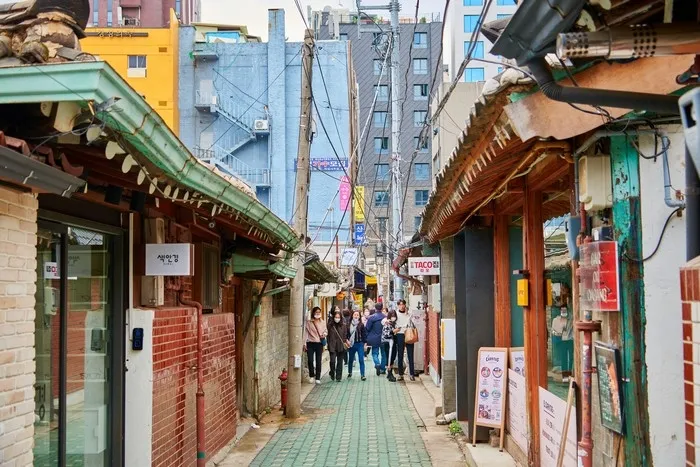
Stand on an ordinary Korean street — not a tourist alley, just a street — and most of the restaurant signs are doing something signs in other countries rarely do: they are telling you the menu.
A sign that ends in 국밥 (gukbap) sells rice in hot soup. A sign that ends in 횟집 (hoet-jip) sells raw fish. A sign that ends in 반점 (ban-jeom) is a Chinese restaurant, every time. The shop’s name is whatever comes before; the last word is what you will eat. If you learned to sound out Hangul in part one of this series, this is the payoff: about a dozen words, and you can stand in any street in the country and know what is behind each door before you open it.
Every definition below is taken from the Standard Korean Dictionary of the National Institute of Korean Language — not from what we assume the words mean.
Read the last word
| The sign ends in | Say it | What is inside |
|---|---|---|
| 국밥 | guk-bap | rice served in hot soup — fast, filling, usually cheap |
| 해장국 | hae-jang-guk | “hangover soup” — the dictionary definition really is soup eaten to settle a stomach unwell from the previous day’s drinking |
| 칼국수 | kal-guk-su | “knife noodles” — wheat noodles rolled thin and cut by hand, served in broth |
| 냉면 | naeng-myeon | cold noodles, usually buckwheat — in icy broth (물냉면, mul-naengmyeon) or with chilli paste (비빔냉면, bibim-naengmyeon) |
| 분식 | bun-sik | “flour food” — tteokbokki, gimbap, ramyeon; the cheapest sit-down food in Korea |
| 백반 | baek-ban | a set: rice, soup and several side dishes, priced as one tray |
| 고깃집 / 구이 | go-git-jip / gu-i | meat you grill at the table |
| 곱창 | gop-chang | beef small intestine, grilled or in stew |
| 족발 | jok-bal | braised pig’s trotters |
| 횟집 | hoet-jip | raw fish, usually with tanks by the door |
| 반점 | ban-jeom | Korean-Chinese food — jajangmyeon, jjamppong |
| 치킨 / 호프 | chi-kin / ho-peu | fried chicken / draught beer — usually the same place |
Two door-frame words complete the kit: 식당 (sik-dang) and 집 (jip) both just mean the place serves food — 식당 is “dining hall,” 집 is literally “house.” When a sign ends in one of those, the word before it is the menu: 국수집 (guk-su-jip) is a noodle house, 순두부식당 (sun-du-bu sik-dang) does soft tofu stew.
Four of these are worth a longer look
국밥 is not pronounced the way it is romanised. The dictionary marks the pronunciation as [국빱] — guk-ppap, with the second consonant tensed hard. The same happens to 백반, marked [백빤] (baek-ppan). Romanisation writes gukbap and baekban and hides this completely, which is why a perfectly-read menu word sometimes draws a blank look. Say it tight and doubled and you will be understood. (This is the sound-change territory part one warned about — the rules are consistent, and they get their own article later in this series.)
백반 is the best-value word on any street. The dictionary defines it as a tray sold at restaurants: rice with soup and several side dishes included — one price, everything on the tray, refills of the side dishes generally free. It is how working Korea eats lunch. What that tray costs varies by region more than you would expect — we went through the government’s price survey dish by dish in our food prices article.
반점 has a story in its two characters. The word is Sino-Korean, written 飯店 — literally “rice shop.” In Korea the dictionary is blunt about what it means:
반점(飯店): 중국 음식을 파는 대중적인 음식점. Banjeom (飯店): an everyday restaurant that sells Chinese food.
National Institute of Korean Language, Standard Korean Dictionary 국립국어원 표준국어대사전 15 August 2026
In Mandarin, the same characters (fàndiàn) more often mean a hotel. In Korea, 반점 means one thing only: a neighbourhood Korean-Chinese restaurant, the home of jajangmyeon (jja-jang-myeon) — noodles in black bean sauce — and jjamppong (jjam-ppong), its spicy seafood counterpart.
호프 came from German. The dictionary lists the origin as Hof and defines it as draught beer sold by the glass, or the pub that sells it. A 호프 is not a restaurant — it is where fried chicken and cold beer meet, the combination Koreans call 치맥 (chi-maek), from 치킨 + 맥주 (maek-ju, beer). If the sign says 호프, go for the chicken and the beer, not for dinner.
The honest warning: some of these words mean pork
족발 is pig’s trotters by definition. The most common gukbap in the southeast is 돼지국밥 (dwae-ji-gukbap) — 돼지 means pig, so the sign itself tells you. But 해장국 and plain 국밥 signs often lead to pork-broth soups without the word 돼지 appearing anywhere, and menus rarely flag it. If you avoid pork for any reason, the sign is not enough — we wrote a separate guide to where pork and fish hide in Korean food, and the one-line defence is to ask: 돼지고기 들어가요? (dwae-ji-go-gi deu-reo-ga-yo? — does this have pork?)
The five stickers on the door
Small signs, usually at eye level on the glass, answer the practical questions:
- 영업중 (yeong-eop-jung) — open now.
- 준비중 (jun-bi-jung) — “preparing”: not open yet, or closed between lunch and dinner. If it is 3 p.m. and the door says this, come back around 5.
- 24시 (i-sip-sa-si) — 24 hours. Common on 국밥 and 해장국 places, which is exactly the food the sign implies people need at 4 a.m.
- 포장 (po-jang) — takeaway available.
- 맛집 (mat-jip) — the dictionary defines it as a restaurant famous for the excellence of its food. On a banner hung by the restaurant itself, it is self-awarded. Treat it as decoration, not evidence.
When the sign is a name, not a menu
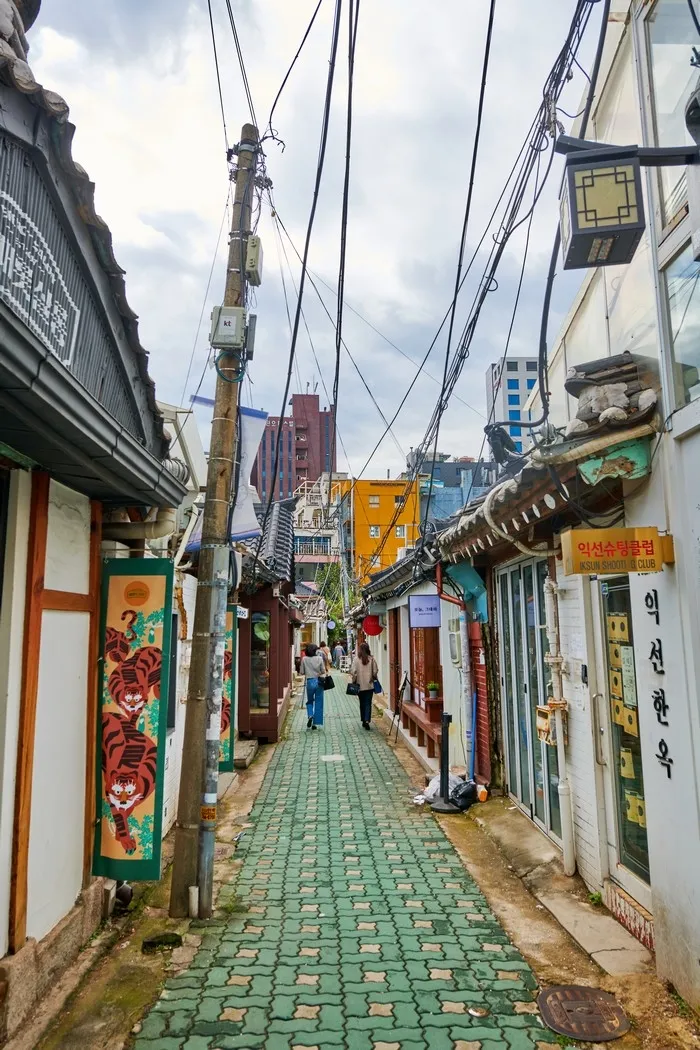
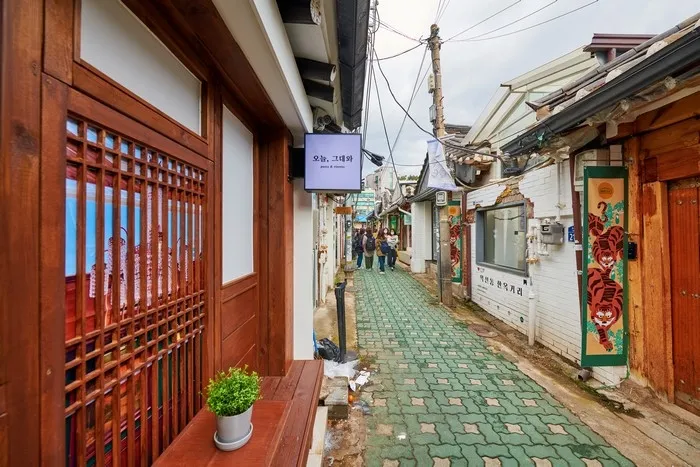
Everything above works on ordinary streets. It works much less well in fashionable districts — Ikseondong (익선동), the hanok alley in these photos, is the clearest example we could show you. The signs here read 오늘, 그대와 (“Today, with you”), 익선한옥 (“Ikseon Hanok”), KRING, TACO. Names and moods, not menus. The old signage logic has been replaced by the logic of places that expect you to have found them on Instagram first.
The fallback is the standing menu board — the A-frame by the door, visible in our top photo. Trendy or not, almost every Korean restaurant puts one out, and the menu words on it are the same dozen words in the table above, plus prices. Read the board, not the signboard.
Through the door
Reading the sign gets you to the right threshold. What happens next — calling the server, ordering, paying — runs on about ten set phrases, and we have written those up separately. And if the table above still looks like a wall of symbols, ninety minutes with part one is genuinely all it takes to change that.
Part three of this series covers the signs you hope not to need: 내과, 이비인후과, 약국 — how to find the right kind of clinic, and why the pharmacy is almost always on the ground floor of the same building.
Read next
Sources & last checked
- Public institution · checked 2026-08-15 표준국어대사전 — 국립국어원 (Standard Korean Dictionary, National Institute of Korean Language)